Brain power and device power for your holiday weekend and beyond

As some of you know, I’ve recently moved across town (why did I want my own yard again?) and flipped my commute from northwest to east-northeast by way of joining Cisco Systems. I will still be blogging here, and possibly more on other sites (like the Perspectives Blog at Cisco) but it’s been a period of resettling lately.

I do want to bring a couple of promotions to your attention… things I like and want to share (see disclosure below).

Packt Publishing $10 for 10th Anniversary

First, if you’re heading into the holiday weekend and looking for some development reading, Packt Publishing is celebrating their 10th anniversary with a $10 deal on all of their eBooks and videos through July 5 (Saturday).

Packt is a smaller publisher of tech materials… they engage writers from the community and bring out books on new and updated topics a bit (or sometimes a lot) faster than the larger and more official tech presses. They cover a broad range of topics and most likely have something you’ll enjoy reading. And if you have unique expertise on your social media or LinkedIn profile, you may hear from them about writing and reviewing opportunities as well.

One of the books they released recently that I’ve been looking forward to is Implementing Cisco UCS Solutions. There is a reliable rumor that Cisco Press is coming out with an updated official UCS tome in the next year (the previous version is about 4 years old now), but in the meantime, you may find this book useful for learning in more detail about Cisco UCS.

So check out this link and see if they have anything you like. The deal goes through Saturday, and their eBooks are DRM-free so you can read them almost anywhere (maybe not your 90s Nokia phone, but hey) and even print from them if you like.

PowerQube Mini portable power strip and charger

Second, for those of you who travel, or like unique outlet strips… take a look at the PowerQube Mini that’s on Kickstarter for the next week.
pqmaxi

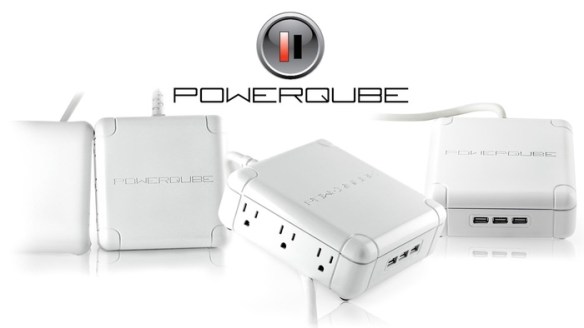
About a year ago, these folks from Indianapolis came out with the original PowerQube. This is a stylish power cube (in the 2d sense, it’s an inch or so tall) with six regular AC outlets and three full power USB charging ports. The PowerQube has integrated electronics letting it send the right power to your devices, whether a little rechargeable speaker that needs 300mA or your iPad or Transformer T100 that wants the heat of a thousand suns. Or 2A. Whichever seems more practical.

I backed the project and got one of the white PowerQubes for $30. It’s a little bit big for solo travel, although I’d bring it with me if I were spending a weekend or a week in a vacation home. And as far as home use, well, it powers my home office desk, and I’m going to get another to power the home network from.

You can find the original PowerQube at Fry’s for $69.95, or order one from Amazon for $59.95. But if you compare what I paid for my Kickstarter model, with the retail price, you may be thinking “how can I get in on this kind of deal?”

pqmini-ac

Well, that’s where the PowerQube Mini Kickstarter comes in. The Mini is a lot smaller, with two AC outlets and three full-power smart USB ports. It also has a detachable IEC power cord, so you could hang this off an underused datacenter PDU or just replace the cord if you need shorter or longer drops.
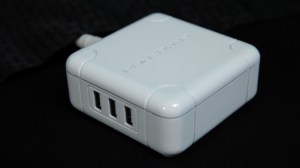
pqmini-usbIf you pledge, and if they make the goal, you can get one Mini for $35 (estimated shipment is September 2014). I went for the silver bundle to get 3 of the Minis at $100 total. But they’d appreciate the support at any level, and I think a lot of my readers would benefit from something like this.

But wait, you’ll get a charge out of this…

Ever wonder what you’re plugging into when you use a public charger? Feel a little paranoid at trade shows or airports but your phone is at 5% and you can’t put it in B&W mode like the new Samsungs?

It turns out there are some unique cables out there that don’t have data connectivity at all. They bridge the lines so you get as much power as your phone or tablet can handle, which means pretty much no risk of having your data accessed surreptitiously, and your phone or tablet may charge in half the time to boot.

I’ve recently stocked up on PortaPow cables from Amazon. PortaPow is a UK company that uses what they call the “Dumb USB specification” to provide charge-only cables in various lengths for MicroUSB devices.

Got an iDevice? Get the MicroUSB to Lightning (or 30pin) adapter from Apple and use it with this. Alternately, PortaPow has a Fast Charge USB Adapter (some people call it a USB Condom) that you put between the source and your existing USB charge cable. Apparently you need the Apple version to get 2A charge through the adapter; I would expect either to work with Android and other standard USB devices.

There are other brands, including Mediabridge (I have three of their cables to test with as well), and if you look for “fast charge usb” you should find others as well. But most of my experience, since buying an ASUS Transformer T100TA with its quirky USB charge requirements, has been with PortaPow, so that’s what I recommend.

So where do we go from here?

I recommend a safe and relaxing weekend of course. That’s my goal as well. Happy Fourth of July to all of you who observe a calendar, whether it’s a holiday or not.

But check out the links above and see if any of this can help with your brain power and device power needs.

Disclosures:

I’ve bought some PacktPub books on my own, and received others on promotion. I will be getting a promo copy or two of their books for this post and related social media excursions.

My PowerQube was purchased through generally available channels (Kickstarter) with my own money, and my pledge for the Mini is out of my own pocket as well, although they may provide promotional consideration in the future.

And the fast-charging USB cables are not a promotion of any sort; I’ve paid out of my own pocket for the dozen or so I have from PortaPow and MediaBridge and others, and I’ll probably buy more since (like scissors and tape) they tend to disappear.
Introducing (and Expanding) the Asigra Cloud Backup Connector Appliance (from the Asigra Partner Summit)

As some of you know, I’m starting a new job soon working with software vendors integrating their products around Cisco platforms. While it’s not my day job yet, I’ve been pondering some less explored options to look into when I do get settled in.

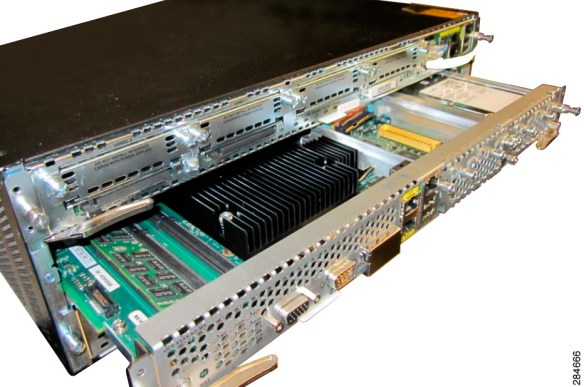
This week I’m at the Asigra Partner Summit in Toronto, with my blogger/technologist hats on. I was a bit surprised to run into a Cisco 2900 ISR (Integrated Services Router) with a UCS E-Series blade module in it, in the hands-on-labs area of the Summit. For me, at least, it’s the unicorn of Cisco UCS; I’ve seen an E-Series system twice now, and once was in the Cisco booth at Cisco Live this year.

What’s this Cisco UCS E-Series all about?

284666[1]The Cisco UCS E-Series blade gives you a single Xeon E5 processor, three DIMM slots, 1-2 2.5″ form factor drives, a PCIe slot, and the manageability of standalone UCS servers without the infrastructure overhead that would be cost- and space-prohibitive in a single or dual node B-Series or C-Series deployment. It does not integrate with UCSM, although you can run multiple blades in an ISR. It’s an intriguing platform for remote office/branch office (ROBO) environments, with the capability to integrate your routing/switching/firewall/network services with your utility server needs, including backup and recovery.

But what’s it doing at the Asigra Partner Summit?

As it turns out, this “Asigra Cloud Backup Connector Appliance” deploys the Asigra Cloud Backup software with the ISR and E-Series platform. It makes sense, and while I wish I’d thought of it sooner, or they’d thought of it later, it is a pretty cool idea.

You can use the appliance as a standalone device, running Asigra DS-Client and DS-System software to collect and store your backups on internal storage. You can also use it as an aggregator or data collector running DS-Client, which would send the data to your DS-System server elsewhere (perhaps a standalone server on-site, or a datacenter or hosted vault).

The one catch is that you’re a bit limited on the internal storage. Cisco has certified 1TB SATA and 900GB 10K SAS drives for the E140DP blade, which means you’re capped at 2TB raw in the server. Asigra has incorporated deduplication in their backup software for over 20 years, so depending on your data you’ll probably see 8-10TB (or more) capacity, but you may still hit some limits.

How do we get around this capacity limit?

If you want to use your Cloud Backup Connector Appliance as a standalone service, I see two possible paths, but each has its drawbacks.

First, since the drive bays are standard 2.5 SATA form factor, you could install your own aftermarket 1.5TB or 2TB drives, doubling your capacity to 3-4TB raw. This means you’re managing your own disks though, and it could complicate Cisco support (although if you’re tearing into the gear you probably already know this and understand the risks).

Second, since you have a PCIe slot in the server, I could imagine either installing a PCIe flash card (such as the 3.2TB  Fusion-io “Atomic” ioMemory SX300 card just announced last week) or a SATA/SAS storage controller connected to some sort of external array.

There are two downsides to this second option. Cisco has not announced certification of anything but a quad-port Gigabit Ethernet or single-port 10-Gigabit Ethernet controller in the PCIe slot (so you’re blazing your own trail if you swap them out–they should work, but…). And if you put storage in that slot, you can no longer expand networking, and will be limited to two internal (chassis) ports and two external (RJ45) ports for Gigabit Ethernet networking. Oh, and a third concern is that you lose the encapsulation factor with your storage hanging off of the server rather than being inside the server.

As I ponder the pitfalls to the PCIe expansion option, I find myself wishing for a dual-Ethernet / SAS card similar to what Sun used to sell for Ethernet and SCSI back in the day. I think HP had a single port combo as well. Alas, both of those are antiquated and are PCI-X instead of PCIe. You could use FCoE from the 10-Gigabit Ethernet card if you have that infrastructure in place, but that might be beyond branch office scale as well.

So what are you saying, Robert?

I may be overengineering this. I’ve done that before. Dual 10-Gigabit in my home lab, for example.

For a branch office with ~20 500GB desktops, a pile of mobile devices, and a server or two, with judicious backup policies, you’re in good shape with the standard configuration. Remember, you’re deduplicating the OS and common files, compressing the backed-up data, and leaving the door open to expanding your Asigra deployment as your branch offices grow.

And if you choose to, you can run a hypervisor on your E-Series server, with Asigra DS-Client/DS-Server VMs as well as your own servers, to the limits of the hardware (6-core CPU, 48GB RAM). The system can boot from SD card, leaving the internal disk entirely for functional storage and VM data stores.

Where do we go from here?

Even with the 2TB raw disk limitation (which will probably be addressed eventually by Cisco), you have a very functional and featureful option for small offices, remote offices, and even distributed campus backup and recovery aggregation.

You get all the benefits of Asigra’s software solution, including agentless backup of servers and desktops, mobile device support, dedupe and compression, FIPS 140-2 certified encryption at rest and in flight, and Asigra’s R2A (Recovery and Restore Assurance) for ongoing validation of your backed-up data.

And you get the benefits of Cisco’s ISR and E-Series platforms for your networking services and server implementation. You can purchase pre-installed systems through an Asigra Service Provider, or if you already own an ISR with an E-Series server, your Service Provider can install and license Asigra software on your existing gear.

Disclosure:

I am attending the Asigra Partner Summit at Asigra’s invitation, as an independent blogger, and the company has paid for my travel and lodging to attend. I have not received any compensation for participating, nor have Asigra requested or required any particular coverage or content. Anything related on rsts11.com or in my twitter feed are my own thoughts and of my own motivation.

Also, while I am a Cisco UCS fanboy and soon to be a Cisco employee, any comments, observations, and opinions on UCS are my own, based on my personal experience as well as publicly available information from Cisco and other vendors. I do not speak for Cisco nor should any of my off-label ideas be taken to imply Cisco approval or even awareness of said musings.

Bad behavior isn’t the right response to bad behavior

tl;dr:

And now on with the show…

Earlier this week Nutanix put out a video campaign against VCE. Many people found it inappropriate or unacceptable. Many people didn’t find it inappropriate or unacceptable. But it offended a very visible contingent of the Internet tech community.

And a bunch of people on Twitter decided to fight inappropriate and unacceptable with the same. For example:

delpo

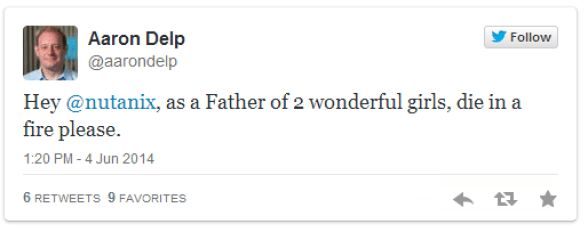
I was told on Twitter last night that “as a father” made this comment acceptable and respectable. Reminded me of the Jenny McCarthy “as a mother” fiasco a few years ago.

There was another tweet telling Nutanix execs that they’d better plan to work in fast food soon… but it looks like that was deleted since last night. If that’s the case, kudos to the poster for thinking better of it. And kudos to Howard Ting, Nutanix’s marketing SVP, for his creative response to that particular tweet.

I was also informed last night on Twitter that being disappointed with this sort of discourse meant I was “white-knighting,” and that an offensive ad campaign was perfect justification for immaturity in return.

The “white knight” term seems to be a popular way of dismissing any disagreement these days, although I hope that ceases to be the case someday. The fellow who made that accusation also accused me of not having a leg to stand on in my position because I stopped arguing with him. Sometimes you just can’t win.

So what’s your point?

Is it really too much to ask, that we keep the level of discourse a bit above what we’re allegedly (i.e. when it’s convenient or attractive or beneficial to us) trying to discourage in others? I don’t think so. As a father, as a technologist, as a human, I don’t think so. And if I’m in the Internet Minority on this, I’m disappointed but okay with it on my side.

I was impressed with a couple of the responses that came from people who missed the memo that they were expected (or even required) to be offended.

The blog post linked in that second tweet is a worthwhile read, although I expect it will be attacked promptly by Nutanix’s competitors and various other people who thrive on feeling outraged.

Nutanix could have done a milder campaign, and I understand they’ve done so already. Should they have started with that? Maybe. Would it have had the same impact? Probably not.

Would it have inconvenienced people looking for something to be outraged about, if they’d started with the new version? Not for long; this is the Internet as you know. Are there hidden (or not-so-hidden) agendas at work in the outrage? I’ll let you decide on that. Will anyone remember this in two months? Other than the folks who are now setting a calendar reminder to stir the pot in two months… probably not.excellent

But those of us with genuine concern about the impressions and realities of sexism, racism, and anythingelse-ism in tech need to take the high road whenever possible. Having a proven history of fertility and/or adoption does not exempt us from being civil. Nor does having a certification, a job, or a social media account. It may not be easy at all times, but change is rarely easy.

Didn’t you have a booth babe thought to share too?

Yes, thanks for reminding me while I still have my asbestos Speedo(tm) on. For that image, you’re welcome.

The blog linked above suggests that people should express outrage about promotional models or “booth babes.”

While I agree with that concern, and I don’t stop at booths that are overwhelmingly ‘babed, there’s a right way and a wrong way to address this issue as well.

I was disappointed to hear some folks at a recent professional trade expo cheerfully and proudly insulting the models themselves, some even claiming knowledge of the models’ alleged (unlikely) alternate professions and sexual proclivities. One or two people I overheard were even thrilled to insult a technologically aware person in a booth who simply made the mistake of being an attractive woman in tech.

The white-knight-decrying fellow can pipe up here if he likes, but insulting or attacking the models themselves–or anyone at a trade show for that matter–will not help your cause or do anyone else any good. Complain politely and professionally to the vendor in question if you want change to happen. Calling the model something you wouldn’t call a person in your family (or that you wouldn’t want someone in your family called) just puts you farther in the wrong than the vendor you’re trying to be outraged at.

Disclosure: I have some people I consider friends over at Nutanix, and I have been a guest at their office for Tech Field Day and just as a friend of the company. However, I don’t have any pigs in the fire on this market at the moment, and nobody has asked or enticed me to write this or given any consideration for this post. And I do have a relative who is a part-time promotional model, albeit in the fashion/club/media world, not the tech world.

The Awesome Power of a Fully Operational Decision-Making Mongoose; or, RASCI as a transitional responsibility model

250px-RASCI[1]I’ll apologize in advance to George Clinton.Video below.
As I prepare to transition out of my current job, my priorities change and I have to be a bit more cautious about what I get involved in, so as to not leave anyone hanging when I do hand over my badge in just over two weeks.

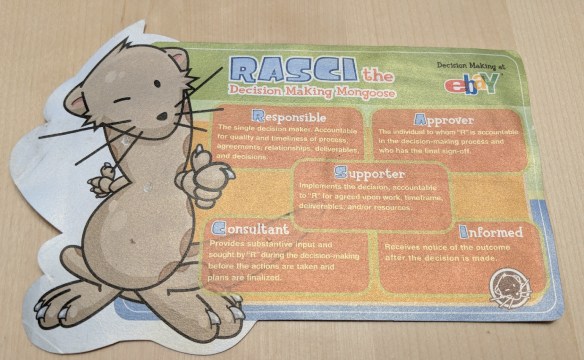
I’m reminded of the decision-making scheme we were taught at eBay–RASCI. That’s

  • Responsible (Person who does the work),
  • Accountable (the person in charge, also Approver of the work R does),
  • Supporting (someone who helps out with the process but is not the main responsible party–sometimes merged into Responsible for RACI),
  • Consulted (subject matter experts who provide advice), and
  • Informed (people who get status updates).

This model was obviously intended to set out expectations and points of responsibility within a project, defining responsibility and telling people who would be on either end of a communications channel as well as who is actually hands-on-keyboards (figuratively or literally) to do the actual work. However, it has another useful role.

At the point where someone gives notice and their countdown begins, they would move into the “C” category. They no longer get action items, presumably no on-call, and the ability to focus on passing along knowledge as needed to the people who would pick up their areas of responsibility.

I’m in the C category now at Disney, There’s a lot to be done, but I can’t take long-term ownership of it anymore. What I can do is work with the folks who are taking over for me, make sure they have the tools and contacts to do their best in my absence.

But what’s this with the mongoose?

Well, that’s controversial. RASCI is the name eBay gave to the mascot for their process, He’s the “decision-making mongoose at eBay.” There was a stuffed version (I have one somewhere in the garage, I’m sure), and it was entertaining and a bit creepy. There was also an unofficial travel blog, with pictures of RASCI in various settings. I can’t find that anymore, but it was out there, I promise.

My fiancee wondered why anyone would need a mascot for decision-making. Fair point, but it does make the model more personally accessible for people who aren’t in project management. And how many mongooses (mongeese?) do you run into in your daily life?

So where do we go from here?

Well, I’m going to Cisco. I don’t know about you guys.

But seriously, RASCI or its variants may be worth considering if you’re having problems with identifying roles in a project, or even if you aren’t yet. You don’t have to use the mongoose, but hey, it’s there.

It’s also worth considering RASCI or the like as a means of communicating a transition of responsibility, whether someone is leaving a project, a department, or the company entirely. Who owns that piece of infrastructure the guy who just left was handling for years? Who remains in the department to provide support and receive reports?

If you have experience with RASCI/RACI, or if you have an extra RASCI doll in need of a new home, let me know in the comments.

And for those of you who might not have known the title reference, have yourself some P.Funk.

[Video link updated 2017-11-30 since the old one has disappeared since 2014.]

[2018-03-02: The card we had to remind us of the RASCI model]

Maker:0x4c,Date:2017-10-14,Ver:4,Lens:Kan03,Act:Lar01,E-YMaker:0x4c,Date:2017-10-14,Ver:4,Lens:Kan03,Act:Lar01,E-Y

Do you know the way to San Jose? Ease on down the road…

tl;dr: In just over 3 weeks I’ll be leaving Disney Interactive, joining Cisco Systems as a Consulting Systems Engineer in Connected Architectures.


Time for some time travel?


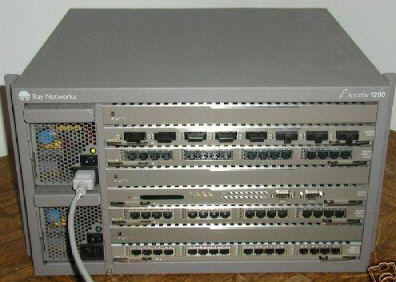
accelar_1200

Fifteen years ago I was working for Nortel Networks in their Ethernet Products Division (formerly the Rapid City Communications acquisition by Bay Networks). I was The Sysadmin for about 180 people at the peak, big data wasn’t even on the horizon yet, and if you’d asked me if I’d ever work with Cisco gear, I would have said “no” without hesitation. I wasn’t planning to become a network guy, and I cut my networking teeth on the Accelar line (now known as Avaya’s ERS 8600 etc) so I leaned that way for many years.

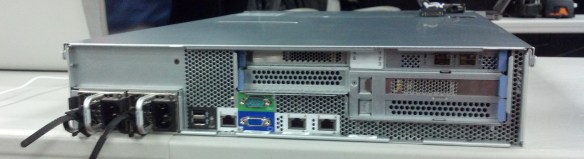
2011-12-22 cisco ucs c210

Fast forward to 2 1/2 years ago, when my boss at Disney asked “do you want to come to the datacenter and see some new servers?” I said yes, as I’ve been a hardware guy my entire career. I arrived at the datacenter to a pile of Cisco UCS C210 servers and the next 2 1/2 years would be spent wrangling C-Series servers into an environment for big data among other things, learning the quirks and questions of integrating with UCSM and communicating the platform out to my internal coworkers.

2014-05-19 rob-smh-clus

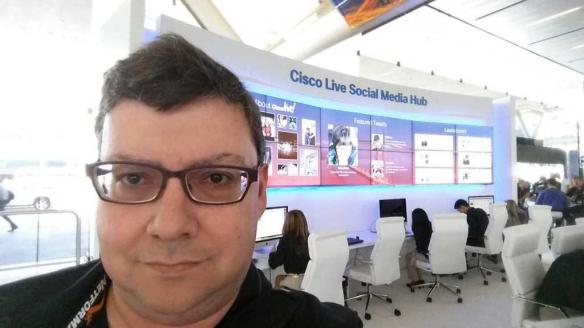
Just under a year ago, I got a message from Rachel Bakker of Cisco’s social media marketing team asking if I’d like to get involved with a new social media outreach program they were starting. My first thought was “do you know who I am?” And it wasn’t in the “I’m way too famous for this” sense, it’s the “do you have the wrong number?” sense. But I guess they knew who I was and wanted me to become one of the first 8 Cisco Champion program members. In the past 10 months, I’ve grown within the Cisco ecosystem and made great connections inside and outside Cisco through both the Cisco Champion program and my interactions with Cisco big data and UCS experts.

1200px-Cisco_Way_VTA_2165_09

In the past week, I got invited to be in a a different track of Cisco Champions. This invitation capped off a long week of Cisco Live in San Francisco, followed by a long weekend moving across town to a bigger home. It’s overwhelming, but exciting. And a little bit scary.

In just under a month, I will be joining Cisco Systems as a Consulting Systems Engineer (CSE) in the Connected Architectures Engineering department. My job will be to work with independent software vendors (ISVs) and channel partners as well as internal Cisco teams to integrate Cisco solutions in Big Data environments.

So where do we go from here?

My three years at Disney Interactive have been productive and inspiring, but I find my future lies along the Tasman Drive road. What a long, strange trip it’s been.

This will be the first time in my professional career that I haven’t been a system administrator of some flavor, but I’ll still be pulling in my systems, infrastructure, architecture, and big picture skills for the adventure. And while I’ll be in the sales division, I won’t be at your door trying to sell you hardware and SmartNet contracts (unless I lose a bet or something).


I’ll also, unfortunately, be off the roster of prospective Tech Field Day delegates, although Stephen Foskett has told me that I’m always welcome at the parties. If invited to participate in roundtables, I’d be happy to join. And if Tech Field Day ever does a Big Data Field Day, I might end up on the other side of the table.


And I plan to keep blogging, experimenting with POHO in all its flavors, and maybe eventually getting my own Cisco UCS gear at home (or more properly, in the garage, for domestic tranquility reasons). So keep following me here, on Twitter as @gallifreyan, and anywhere else you find me. I won’t be alone, dancing, you know it baby….