
Opengear switches things up at Interop ITX 2017

Opengear, established in 2004, is one of those companies whose products aren’t always visible, but tend to be there when you need them. Starting out with traditional serial console servers used to provide remote out-of-band management access, they’ve expanded that scope over the past 13 years to include monitoring software, Ethernet and cellular failover, centralized management of their appliances, and zero-touch provisioning from the systems themselves.

I sat down with Todd Rychecky, VP of Sales for the Americas business at Opengear, during Interop ITX 2017 in Las Vegas in mid-May to get a feel for how things have been going for Opengear lately.

Let’s just say they’re going well.

The business itself has been growing 50% year-over-year for the past 9 years–and Rychecky’s sales force has been expanding along with the company’s engineering team. This was impressive to hear, for a technology that many don’t even think about anymore. But following the needs for the technology is what has kept Opengear going for the past decade, driving the company to over 30% cellular deployment in 7 years of integrating mobile data networks.

Larger businesses with hyperscale infrastructure have been coming to Opengear for the highly resilient, centrally manageable SmartOOB devices they provide. Having bidirectional fault-tolerant connectivity options (including Ethernet, multiple cellular connections, and even POTS-based modems) helps in environments where reliable in-band connectivity may be more of a dream than a reality. And the growth in hyperscale infrastructure deployments has spread into traditional large enterprise.

They’ve also added to their industry expertise with the recent addition of CTO Marcio Saito, formerly CTO at Bay Area pioneer Cyclades (later acquired by Avocent). With sixteen years of adjacent experience, including the sorts of growth that Opengear is going through now, Saito looks to be an interesting accelerator for the business.

But what’s on the truck?

Opengear announced the newest member of the IM7200 Infrastructure Manager family, the IM7216-2-24E line of hybrid serial-and-Ethernet devices.

2017-05-17 16.22.32 Opengear New 7200 back

Featuring a 16-port serial console segment alongside a 24-port Gigabit Ethernet switch, the 24E products offer WiFi, v.92 modem (pictured here) or multi-carrier-friendly LTE, and copper/SFP gigabit uplink ports as well as dual power supplies.
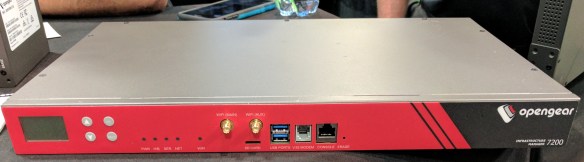
2017-05-17 16.22.41 Opengear New 7200 Front

The IM7200 systems come with 16GB of internal flash storage, expandable via a pair of USB 3.0 ports on the front. If you’re using these boxes as install servers, which would be a great use for the Ethernet switch, you can set up your ISO or package repositories to serve up OS and configuration, from DCHP to deployment.

im7216-2-24u-dac-rear

For users wanting to manage the growing volume of devices with USB-based consoles, the IM7216-2-24U line offers 24 USB type A ports instead of the Ethernet switch. This product came out since Interop 2016 (around the time of Cisco Live US in 2016 to be precise), and I’m not sure how I missed it at that time. The 24U models offer Gigabit Ethernet uplinks, v.92 modem, WiFi, and optional multi-carrier LTE like the other models in the IM7200 product family.

So where do we go from here?

Opengear is continuing to go up, increasing their staffing, opening a new office in Silicon Valley to support hyperscale and enterprise businesses here, and finding new opportunities to supplement and replace legacy console servers going out of sale.

I’ll be putting one or two of their smaller devices through its paces this summer in the lab. Last year, Opengear provided me with a four port Resilience Gateway to explore, and back in January I mentioned that I’d be trying it out with Google’s Project Fi data-only SIM as well as Verizon for the cellular functionality. Enterprises are unlikely to use the Fi option, but home lab and POHO users may find it easier to implement than a Big Four cellular contract.

Be sure to catch up with Opengear at Cisco Live US in Las Vegas. They’ll be at booth 937 between the Collaboration and Cloud/Data Center villages, near the Cisco Live broadcast studio.

Have you found an interesting use for Opengear’s gear? Or are you out of the console world these days? Share your thoughts in the comments below.

Disclosure: I attend InteropITX as independent media, unrelated to and unaffiliated with my day job. Neither UBM/InteropITX nor Opengear have influence over or responsibility for any of my coverage.

Photos of the 24E device by Robert Novak (C)2017. Photo of the 24U device courtesy of Opengear.

What verse are we on? The fifth! Back at Interop ITX Las Vegas

I’m back in Las Vegas for my fourth time this MLife season, and my fifth time at Interop (now Interop ITX). And it’s a little bit different this year. [Disclosures below]

Quick takes:

The most obvious change is the venue; they announced at the end of Interop 2016 that the event would move to MGM Grand’s Conference Center, one  Las Vegas block down the Strip from its previous home at Mandalay Bay. This means a smaller, more focused event, as MGM has a smaller facility than Mandalay, but it likely also means more affordable accommodations at the event hotels. (I would have enjoyed an extra Amex FHR stay at Delano, but Signature at MGM is good enough.)

Some staff changes have happened, particularly Meghan Reilly taking the reins of the event from Jennifer “JJ” Jessup, who moved on to a different company and role after last year’s event. JJ and the team encouraged me to stay involved with the event even after going to the Dark Side, and I’m grateful for her influence over the past few years. But I haven’t seen any fallout from the transition yet. The staff keeps things going, even with the traditional Monday hiccups on food and beverage logistics.

There also seems to be more of a focus on the educational content as opposed to the expo floor. Well over a dozen in-depths events will occupy each day Monday and Tuesday, with prominent names from various corners of the IT ecosystem. The “Business Hall” is still there, and will have about a hundred exhibitors according to the Interop website, but people have noticed many of the big names of past years scaled back or passing on the event altogether.  I’ve also seen some of my perennial favorites sit this one out.

I would say both of these items are good, for various reasons. While it was beneficial to have the Monsters of IT(tm) on the floor pitching their latest wares, I would expect this year to allow more of a focus on new, more agile, more adaptable players in the market. And with what seems (to me at least) to be a stronger focus on content vs exhibitors, the event becomes even more of a unique, substantially community-driven, substantially vendor-independent tech conference.

It’s true that if you want to see Cisco, Dell, and HP side by side, you’re mostly out of luck unless you find a third party proprietary conference (like VMworld or SAP Sapphire), but I expect that increased exposure to the new and rising players will have a positive effect on some of the larger companies. As each of the giants realizes they can’t differentiate based on their own true believers alone–and to be honest, that’s the core of each vendor’s own conference–perhaps they’ll come back to the table.

It’s also true that, if you are looking for more general IT and technology coverage than the USENIX events offer, especially around the business and culture side of IT, Interop ITX is pretty much the only game left in town.

Where do we go from here?

I’ll be heading into some content today and tomorrow, in between working on some other slides and writing. If you’re brave, follow me on Twitter at @gallifreyan for realtime observations, or if you’re attending Interop ITX, follow me on the app.

Disclosure: I attend Interop as independent media, on personal vacation time, not under the auspices of my day job. Tech Field Day generously brought me here my first two years, but for the past three years inclusive, I have attended on my own dime (although Interop does provide media attendees with lunch and coffee as well as full access to the conference). Any opinions in my coverage of the event are mine alone, and have not seen prior review by anyone involved in the event.

Further disclosure: autocorrect is being religious as I write this on my iPad. JJ’s last name became Jesus quite often, and apparently Apple wants Interop to have a stronger focus on convent. I’ll have nun of that, thank you.

Five fun and useful uses for an extra PCI slot

Anytime I pick up a “new” desktop/server/workstation class system, I check out the available PCI slots to see what my I/O options will be. There’s usually some open space there, and sometimes (especially when I’m building a system from board+case) there will be available “slots” on the case with no corresponding PCI slot on the system board.

Based on a recent home office closet cleaning, I’ve been inspired to share my top five uses for a spare slot.  Continue reading →

System Build Report: A Xeon-D “HTPC” for FreeBSD Corral or VMware vSphere

I’ve been planning to do some network testing and deploy some new storage for VMware vSphere in the home lab. My Synology NAS boxes (DS1513+ and DS1813+) have good performance but are limited to four 1GbE ports each, and my budget won’t allow a 10GbE-capable Synology this spring. [See below for a note on those $499 Synology systems on Amazon.] Continue reading →

I’ve looked at clouds from both sides now – are they just vapor?

For those of you not of a certain age… a bit of a soundtrack for this post.


I wrote last month about the “antsle” “personal cloud server,” and a few people on Minds had a brisk but respectful debate over whether it was cloud, and whether there was more to cloud than cloud storage (i.e. Dropbox, Box, Owncloud, OneDrive, Sugarsync, etc).

It got me to thinking about how I’d define “cloud” and why others feel differently. So here’s a bit of a soft-topic consideration for you along the way.

I was first exposed to the buzzword around 2009, when a major PC and IT gear reseller from the midwest was trying to convince me on every call and email thread that I should buy The Cloud(tm). My rep never could tell me why, or what problem it would solve, a common shortcoming of quota-bound sales reps. I think the closest to a justification I ever got was “Just give a try, you’ll be able to tell where you can use it.” And I didn’t.

As the current decade rolled along, anyone running the server side of a client/server model called themselves The Cloud(tm). And of course, Amazon Web Services and other players came along to give their own definitions and market shares to the matter.

Today, at its extreme interpretation, anything not running in focus on your current personal device is probably considered “cloud” by someone. And to be fair to antsle, that’s where they fit in a way.  Continue reading →