
These 3 hot new trends in storage will blow your mind! Okay, maybe not quite. (2/2)

I’ve attended a couple of Tech Field Day events, and watched/participated remotely (in both senses of the word) in a few more, and each event seems to embody themes and trends in the field covered. Storage Field Day 5 was no exception.

I found a couple of undercurrents in this event’s presentations, and three of these are worth calling out, both to thank those who are following them, and give a hint to the next generation of new product startups to keep them in mind.

This post is the second of a series of two, for your manageable reading pleasure. The first post is here.

Be sure to check out the full event page, with links to presenters and videos of their presentations, at http://techfieldday.com/event/sfd5/

3. The Progressive Effect: Naming Names Is Great, Calling Names Not So Much

Back at the turn of the century, it was common for vendors to focus on their competition in an unhealthy way. As an example, Auspex (remember them) told me that their competitor’s offering of Gigabit Ethernet was superfluous, and that competitor was going out of business within months. I’ll go out on a limb and say this was a stupid thing to say to a company whose product was a wire-speed Gigabit Ethernet routing switch, and, well, you see how quickly Netapp went out of business, right?

At Storage Field Day 5, a couple of vendors presented competitive/comparative analysis of their market segment. This showed a strong awareness of the technology they were touting, understanding of what choices and tradeoffs have to be made, and why each vendor may have made the choices they did.

Beyond that, it can acknowledge the best use for each product, even if it’s the competition’s product. I’ll call this the Progressive Effect, after the insurance company who shows you the competitor’s pricing even if it’s a better deal. If you think your product is perfect for every customer use case, you don’t know your product or the customer very well.

Once again, Diablo Technologies did a comparison specifically naming the obvious competitor (Fusion-io), and it was clear that this was a forward-looking comparison, as you can order a hundred Fusion-io cards and put them into current industry standard servers. That won’t work with most of the servers in your datacenter with the ULLtraDIMMs just yet. But these are products that are likely to be compared in the foreseeable future, so it was useful context and use cases for both platforms were called out.

Solidfire’s CEO Dave Wright really rocked this topic though, tearing apart (in more of an iFixit manner than an Auspex manner) three hyperconverged solutions including his own, showing the details and decisions and where each one makes sense. I suspect most storage company CEOs wouldn’t get into that deep of a dive on their own product, much less the competition, so it was an impressive experience worth checking out if you haven’t already.

There were some rumblings in the Twittersphere about how knowing your competitor and not hiding them behind “Competitor A” or the like was invoking fear, uncertainty, and doubt (FUD). And while it is a conservative, and acceptable, option not to name a competitor if you have a lot of them–Veeam chose this path in their comparisons, for example–that doesn’t mean that it’s automatically deceptive to give a fair and informed comparison within your competitive market.

If Dave Wright had gone in front of the delegates and told us how bad all the competitors were and why they couldn’t do anything right, we probably would’ve caught up on our email backlogs faster, or asked him to change horses even in mid-stream. If he had dodged or danced around questions about his own company’s platform, some (most?) of us would have been disappointed. Luckily, neither of those happened.

But as it stands, he dug into the tech in an even-handed way, definitely adding value to the presentation and giving some insights that not all of us would have had beforehand. In fact, more than one delegate felt that Solidfire’s comparison gave us the best available information on one particular competitor’s product in that space.


This is a post related to Storage Field Day 5, the independent influencer event being held in Silicon Valley April 23-25, 2014. As a delegate to SFD5, I am chosen by the Tech Field Day community and my travel and expenses are covered by Gestalt IT. I am not required to write about any sponsoring vendor, nor is my content reviewed. No compensation has been or will be received for this or other Tech Field Day post.


These 3 hot new trends in storage will blow your mind! Okay, maybe not quite. (1/2)

I’ve attended a couple of Tech Field Day events, and watched/participated remotely (in both senses of the word) in a few more, and each event seems to embody themes and trends in the field covered. Storage Field Day 5 was no exception.

I found a couple of undercurrents in this event’s presentations, and three of these are worth calling out, both to thank those who are following them, and give a hint to the next generation of new product startups to keep them in mind.

This post is one of a series of two, for your manageable reading pleasure. Part two is now available here.

Be sure to check out the full event page, with links to presenters and videos of their presentations, at http://techfieldday.com/event/sfd5/

1. Predictability and Sustainability Are The Right Metrics

There are three kinds of falsehoods in tech marketing: lies, damned lies, and benchmarks. Many (most?) vendors will pitch their best case, perfect environment, most advantageous results as a reason to choose them. But as with Teavana’s in-store tasting controversy, when you get the stuff home and try to reproduce the advertised effects, you end up with weak tea. My friend Howard Marks wrote about this in relation to VMware’s 2-million IOP VSAN benchmark recently.

At SFD5, we had a couple of presenters not stress best case/least real results, but predictable and reproducible results. Most applications aren’t going to benefit a lot from a high burst rate and tepid average performance whether it’s on the server hardware, storage back-end, or network. But consistent quality of service (QoS) and a reliable set of expectations that can be met (and maybe exceeded) will lead to satisfied customers and successful implementation.

One example of this was with Diablo Technologies, the folks behind Memory Channel Storage implemented by Sandisk as ULLtraDIMM. In comparing the performance of the MCS flash implementation against a PCIe storage option (Fusion-io’s product, to be precise), they showed performance and I/O results across a range of measurements, and rather than pitching the best results, they touted the sustainable results that you’d expect to see regularly with the product.

Sandisk themselves referred to some configuration options under the hood, not generally available to end users, to trade some lifespan for daily duty cycles. Since these products are not yet mass market on the level of a consumer grade 2.5″ SSD, it makes sense to make that a support/integration option rather than just having users open up a Magician-like product to tweak ULLtraDIMMs themselves.

Another example was Solidfire, who also advocated setting expectations to what would be sustainable. They refer to “guaranteed performance,” which comes down to QoS and sane configuration. Linear scalability

2. Your Three Control Channels Should Be Equivalent

There are generally three ways to control a product, whether it’s a software appliance, a hardware platform, or more. You have a command-line interface (CLI), a graphical user interface (GUI) of some sort–often either a web front-end or an applet/installed application, and an API for automated access (XML, REST, SOAP, sendmail.cf).

I will assert that a good product will have all three of these: CLI, GUI, API. A truly mature product will have full feature equity between the three. Any operation you can execute against the product from one of them can be done with identical effectiveness from the other two.

This seems to be a stronger trend than it was a couple of years ago. At my first Tech Field Day events, as I recall, there were still people who felt a CLI was an afterthought, and an API could be limited. When you’re trying to get your product out the door, before your competitor locks you out of the market, it could be defensible, much as putting off documentation until your product shipped was once defended.

But today, nobody should consider a product ready to ship until it has full management channel equality. And as I recall, most of the vendors we met with who have a manageable product (I’m giving Sandisk and Diablo Tech a pass on this one for obvious reasons) were closer to the “of course we have that” stance than the “why would we need that” that used to be de rigueur in the industry.

Once again, this is part one of two on trends observed at Storage Field Day 5. Part 2 is now available at this link.

This is a post related to Storage Field Day 5, the independent influencer event being held in Silicon Valley April 23-25, 2014. As a delegate to SFD5, I am chosen by the Tech Field Day community and my travel and expenses are covered by Gestalt IT. I am not required to write about any sponsoring vendor, nor is my content reviewed. No compensation has been or will be received for this or any other Tech Field Day post. 

How do you solve a problem like Invicta? PernixData and external high performance cache

PernixData and unconventional flash caching

We spent a captivating two hours at PernixData in San Jose Wednesday. For more general and detailed info on the conversations and related announcements, check out this post by PernixData’s Frank Dennenman on their official blog, and also check out Duncan Epping’s post on YellowBricks.

At a very high and imprecise level, PernixData’s FVP came out last year to provide a caching layer (using flash storage, whether PCI-E or SSD) injected at the vmkernel level on VMware hypervisors. One big development this week was the option to use RAM in place of (or in addition to) flash as a caching layer, but this is unrelated to my thoughts below.

One odd question arose during our conversation with Satyam Vaghani, CTO and co-founder of PernixData. Justin Warren, another delegate, asked the seemingly simple question of whether you could use external flash as cache for a cluster (or clusters) using PernixData’s FVP. Satyam’s answer was a somewhat surprising “yes.”

I thought (once Justin mentioned it) that this was an obvious idea, albeit somewhat niche, and having worked to get scheduled downtime for a hundred servers on several instances in the past year, I could imagine why I might not want to (or be able to) shut down 100 hypervisor blades to install flash into them. If I could put a pile of flash into one or more centrally accessible, high speed/relatively low latency (compared to spinning disk) hosts, or perhaps bring in something like Fusion-io’s Ion Accelerator platform.

I took a bit of ribbing from a couple of other delegates, who didn’t see any situation where this would be useful. You always have plenty of extra spare hypervisor capacity, and flash that can go into those servers, and time and human resources to handle the upgrades, right? If so, I mildly envy you.

So what’s this about Invicta?

Cisco’s UCS Invicta platform (the evolution of WHIPTAIL) is a flash block storage platform based on a Cisco UCS C240-M3S rackmount server with 24 consumer-grade MLC SSD drives. Today its official placement is as a standalone device, managed by Cisco UCS Director, serving FC to UCS servers. The party line is that using it with any other platform or infrastructure is off-label.

I’ve watched a couple of presentations on the Invicta play. It hasn’t yet been clear how Cisco sees it playing against similar products in the market (i.e. Fusion-io Ion Accelerator). When I asked on a couple of occasions on public presentations, the comparison was reduced to Fusion-io ioScale/ioDrive PCIe cards, which is neither a fair, nor an applicable, comparison. You wouldn’t compare Coho Data arrays to single SSD enclosures. So for a month or so I’ve been stuck with the logical progression:

  1. Flash is fast
  2. ???
  3. Buy UCS and Invicta

Last month, word came out that Cisco was selling Invicta arrays against Pure Storage and EMC XtremIO, for heterogeneous environments, which also seems similar to the market for Ion Accelerator. Maybe I called it in the air. Who knows? The platform finally made sense in the present though.

Two great tastes that taste great together?

Wednesday afternoon I started putting the pieces together. Today you can serve up an Invicta appliance as block storage, and probably (I haven’t validated this) access it from a host or hosts running PernixData’s FVP. You’re either dealing with FC or possibly iSCSI. It will serve as well as the competing flash appliances.

But when Cisco gets Invicta integrated into the UCS infrastructure, hopefully with native support for iSCSI and FCoE traffic, you’ll be talking about 10 gigabit connections within the Fabric Interconnect for cache access. You’ll be benefiting from the built-in redundancy, virtual interface mapping and pinning, and control from UCS Manager/UCS Central. You’re keeping your cache within a rack or pod. And if you need to expand the cache you won’t need to open up any of your servers or take them down. You’d be able to put another Invicta system in, map it in, and use it just as the first one is being used.

If you’re not in a Cisco UCS environment, it looks like you could still use Invicta arrays, or Fusion-io, or other pure flash players (even something like a whitebox or channel partner Nexenta array, at least for proof-of-concept).

So where do we go from here?

The pure UCS integration for Invicta is obviously on the long-term roadmap, and hopefully the business units involved see the benefits of true integration at the FI level and move that forward soon.

I’m hoping to get my hands on a trial of FVP, one way or another, and possibly build a small flash appliance in my lab as well as putting some SSDs in my C6100 hypervisor boxes.

It would be interesting to compare the benefits of the internal vs external flash integration, with a conventional 10GBE (non-converged) network. This could provide some insight into a mid-market bolt-on solution, and give some further enlightenment on when and why you might take this option over internal flash. I know that I won’t be able to put a PCIe flash card into my C6100s, unless I give up 10GBE (one PCIe slot per server, darn). Although with FVP’s newly-announced network compression, that might be viable.

What are your thoughts on external server-side cache? Do you think something like this would be useful in an environment you’ve worked with? Feel free to chime in on the comments section below.

This is a post related to Storage Field Day 5, the independent influencer event being held in Silicon Valley April 23-25, 2014. As a delegate to SFD5, I am chosen by the Tech Field Day community and my travel and expenses are covered by Gestalt IT. I am not required to write about any sponsoring vendor, nor is my content reviewed. No compensation has been or will be received for this or other Tech Field Day post. I am a Cisco Champion but all Cisco information below is public knowledge and was received in public channels.

FirmwareGate and FCoEgate two months later

I was surprised last week at Interop to hear people still talking about both FCoEgate and HP FirmwareGate. It seems that in the absence of any clarity or resolution, both still bother many in the industry.

For those of you who missed the early February drama (and my relevant blog post):

FCoE-gate

FCoEgate: An analyst group called The Evaluator Group released a “seriously flawed” competitive comparison between an HP/Brocade/FC environment and a Cisco/FCoE environment. Several technical inquiries were answered with confusing evidence that the testers didn’t really know what they were doing.

Several people I talked to at Interop mentioned that this was a perfectly understandable mistake for a newbie analyst, but experienced analysts should have known better. Brocade should have known better as well, but I believe they still stand by the story.

The take-home from this effort is that if you don’t know how to configure a product or technology, and you don’t know how it works, it may not perform optimally in comparison to the one you’re being paid to show off.

This one doesn’t affect me as much personally, but I’ll note that there doesn’t seem to have been a clear resolution of the flaws in this report. Brocade has no reason to pay Evaluator Group to redo a valid comparison, and technologists worth their salt would see through it anyway (as many have). So we have to count on that latter part.

FirmwareGate

https://twitter.com/ProLiant/status/433252908755582976

FirmwareGate: HP’s server division announced that, for the good of their “Customers For Life,” they would stop making server firmware available unless it was “safety and security” updates. How can you tell if it’s “safety and security?” Try to download it.

HP claimed repeatedly that this brings them in line with “industry best practices,” thus defining their “industry” as consisting exclusively of HP and Oracle. I don’t know any working technologists who would go along with that definition.

HP promised clarification on this, and defended their policy change by declaring industry standard x86/x64 servers as equivalent to commercial operating system releases and Cisco routers.

They even had a conversation with my friend John Obeto, wherein they convinced him that nothing had changed. Ah, if only this were true. (It isn’t.)

But I had fleeting faith that maybe they’d fixed the problem. So I went to get the firmware update for a nearly 2-year-old Microserver N40L, which had a critical firmware bug keeping it from installing a couple of current OSes. Turns out it’s not a “safety and security” fix, and my system apparently came with a one year warranty.

So if I wanted to run a current Windows OS, I either have to spend more on the support contract than I did on the server (if I can find the support contract anymore), or go with an aftermarket third party reverse-engineered firmware (which, unlike HP’s offerings actually enhances functionality and adds value).

Or I can go with the option that I suspect I and many other hobbyists, home lab users, influencers, and recommenders will — simply purchase servers by companies that respect their customers.

What should HP be doing instead?

The “industry best practices” HP should be subscribing to include open access to industry standard server firmware that fixes bugs they delivered, not just vaguely declared “safety and security” upgrades, much as every other industry standard server vendor except Oracle does. That includes Dell, Cisco, Supermicro, Fujitsu, NEC, Lenovo/IBM, and probably a number of other smaller players.

As my friend Howard Marks noted, some of us would be satisfied with a software-only or firmware-only support contract. On-site hardware maintenance isn’t necessary or even affordable for many of us. Many of us who buy used servers would be better off buying an extra server for parts, and most of us buying used servers know how to replace a part or swap out a server. Some of us even better than the vendor’s field engineers.

HP has been silent on this matter for over a month now, as far as I can tell. The “Master Technologists” from HP who won’t distinguish an MDS router from an x86 server have gone silent. And I’m sure many of the “customers for life” that the 30-year HP veteran graciously invites to keep buying support contracts will start looking around if there’s not a critical feature in HP servers that they need.

So where do we go from here?

I can no longer advocate HP servers for people with budgets containing fewer than 2 commas, and even for those I’d suggest thinking about what’s next. There are analogous or better options out there from Dell, Cisco, Supermicro, Fujitsu, NEC, Lenovo, and for the smaller lab form factors, Intel, Gigabyte, Shuttle, and others. (It’s also worth noting that most of those also provide fully functional remote management without an extra license cost as well.)

If you do want to go with HP, or if you can’t replace your current homelab investment, there are ways to find firmware out there (as there has been in the past for Sun^wOracle Solaris). It took me about 15 minutes to find the newly-locked-down Microserver firmware, for example. It didn’t even require a torrent. I can’t advocate that path, as there may be legal, ethical, and safety concerns, but it might be better than going without, at least until you can replace your servers.

And I’ve replaced most of my HP servers in the lab with Dell servers. One more to go. If anyone wants to buy a couple of orphaned DL servers in Silicon Valley (maybe for parts), contact me.

If anyone else has seen any clarity or correction in the state of FCoEgate or FirmwareGate in the last month or so, let me know in the comments. I’d love to be wrong.

Interop Las Vegas 2014 – Highlights, Lowlights, Footlights

I’m back from a week in Las Vegas for the annual Interop convention. Had some great conversations with vendors and technologists, got punched by Mark Twain, and graduated to the next level of mLife. I’ll have more to talk about in the next weeks, but I wanted to share some summary thoughts for those of you who are curious.

Disclosure: I attended Interop on a media/blogger pass, which was provided at no cost to myself, under the auspices of Tech Field Day. However, travel and incidentals were out of my own pocket, and aside from some trinkets that were offered to everyone in the expo, I have received no valuable consideration from any of the companies mentioned in this post. If this changes, I will advise in future articles.

My other coverage: “A Context For Cloud” covering my interpretations of Adrian Cockcroft’s Cloud Connect Summit opening keynote.

Good Stuff, Maynard

I’ve written before about how obnoxious the badge scanners can be at trade shows. This year’s Interop brought (I believe) a new feature that almost makes the scanners worthwhile — a trip report summarizing my event contacts and sessions. As I was leaving Las Vegas, I got an email that pointed me to a listing of my Interop sessions, surveys for the ones I hadn’t filled out, and the exhibitors who scanned my badge (or at least most of them… the list seems short, but some of the vendors were polite about not scanning–especially the ones I already communicate with weekly). I hope that other conventions like Cisco Live and VMworld add this functionality as well.

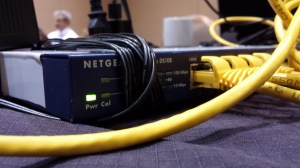
2014-04-01 11.37.07The Media Lounge was well-appointed, fiercely guarded by the incredible UBM PR team, populated with coffee, very edible breakfast and lunch at appropriate times, electricity and network connectivity, and except for the UNLV marching band incident, relatively quiet. It even featured a Bay Networks-branded Netgear dual-speed hub.

The best swag of the event (for me) is probably a tie between the Backupify Travel Hoodie Pillow and the 15% Off coupon for the new Linksys WRT1900AC.

The best physical technology I saw at the event would be the 16GB DDR3 SODIMM from Memphis Electronic, the Linksys WRT1900AC (luckily the big one isn’t the one that’s shipping next week), and the new Shuttle DS81 (Haswell compact system with dual 4k) video.

The best soft topics I saw included Circle Technology’s Circle Host/Circle Viewer private network screen share technology and Synology’s DSM 5.0 Central Management System.

And unrelated to Interop, I got notification on April 1 (seriously) that I was selected again as a VMware vExpert for 2014-2015. I continue to feel humbled and honored by this designation, and I hope to continue to provide useful contributions to the POHO community around virtualization technology.

Not So Good Stuff, Maynard

I’ll admit the first shock I got was the “Airline Chicken” in the media room at lunch. Several of the other folks in the room and I were concerned about an association between food and airplanes, having eaten on airplanes before. However, Meredith Corley from UBM Tech PR helped us get over that concern by looking up the worrisome product. It wasn’t so worrisome after all.

We did see a couple of “unclear on the concept” moments during the Expo, especially around “sponsorship” of refreshments. I believe Verisign “sponsored” the welcome reception on Tuesday, which made it possible for us to have cans of soda for only $4.25 each. Spiceworks apparently “sponsored” the coffee stand at the entrance, again with the $5 beverages. In the future, I’d suggest finding a different term, or perhaps making it clear how to take advantage of the sponsorship. Even the hotel only wanted $3.25 for a 20oz bottle of soda, and that’s not even sponsored.

And unrelated to Interop itself, I will restate that I hate hotel pillows.

One suggestion I will throw out there… if it would be possible to have lockers for media/bloggers (if not for everyone), so that we can leave laptops securely stowed during Expo and evening events without going all the way back to the hotel, that would be a welcome enhancement. I do think next year I will probably stay in the Mandalay Bay hotel, to optimize mLife points and minimize commute.

All things considered, not much to complain about.

Things to watch for

I had good conversations with a couple of vendors during the event.

Check out the links in this graf for each company’s Tech Field Day presentations.

I also had a charming conversation about security and network compliance and Doctor Who with Andy Williams, Nicola Whiting, and Ian Whiting of Titania. They have a compelling product line for auditing network device configurations, and weren’t too shocked that Rowan Atkinson was my Doctor.

So where do we go from here?

Well, for me, I’m catching up on a week’s email and then headed back to Las Vegas on Friday to work on some work stuff (seriously). No rest for the wicked, and PTO never seems to reduce the backlog of work.

Coming up in about 2 weeks is Storage Field Day 5 featuring Diablo Technologies, EMC, PernixData, Sandisk, Solidfire, Veeam, and X-Io. I’ve threatened to blog more from this event, although I’ll also be providing realtime feedback and twitter analysis as usual.

If you think I left out a highlight of Interop, or if you’d like to share your feedback, the comments are open. Hope to hear from you down there.