Greetings from Storage Developer Conference 2012

I’m in Santa Clara this week (a whopping five miles from home) for the SNIA Storage Developer Conference (SDC).

I’m here as a guest of SNIA and Gestalt IT, who are sponsoring my attendance. I’ll be participating in daily SDC Tech Field Day roundtables–check out techfieldday.com at 2pm Monday and 1:30pm Tuesday and Wednesday, Pacific Time, to see my TFD colleagues and I review the past day’s material from the perspective of the end user of storage technologies.

An Englishman In New York?

I’ve been doing storage beyond DAS since 2001 (A Disk Space Odyssey?), and dabbled in the Windows interoperability world. But some of this material is way over my head. I’m a sysadmin by trade, not a storage developer or hardware designer. When I asked my boss for time off to come to this conference, he asked “do you really want to develop for storage?” And in the sense of writing code, no. I don’t care to write a line of code under the covers at this point.

But in the sense of growing in my experience, my trade, and my awareness of things that I’m not quite blamed for yet, definitely, I’d like to develop for storage.

It is good to get a sense of perspective. As some of you may commiserate with, I’ve been known to work with “experts” who know things that make no sense in the real world. CIFS/SMB is dead. Hadoop is dead. Hardware is dead. Vegan cookies are tasty.

This week I’m hearing from some of the most prominent people in the storage industry from the functional side (as opposed to the commercial product and sales side), and even if a fair bit of it is above my clue grade, it’s giving me perspective. And even if it’s not always useful to correct those “experts,” it’s good to know for myself and my own work what’s really worth knowing.

As I started writing this post, I was in a room with kernel and Samba developers and a lot of other people who work miracles in very low level code for the CIFS/SMB2/SMB3 layers in Linux. Steven French from IBM, who wrote the original CIFS support for Linux, was speaking, and getting corrected by some of the people who are qualified to do so.

Not all experts take correction well. The ones who admit when they’re wrong are the ones you want to pay attention to, unless you like driving around in circles. I’m expecting quite a few of that sort of expert this week at SDC. The ones that know their stuff but can still learn/refine, that is, not the ones who drive around in circles.

Back To The Fray

I’m going to get back to my sessions… tune in online at http://techfieldday.com/event/rsdc12/ (or come to the mezzanine if you’re here at SDC) for the first Tech Field Day roundtable today at 2:00pm Pacific time. And follow me at @gallifreyan on Twitter to see sporadic live comment on whatever I’m watching at the time.

Disclaimer: SNIA and Tech Field Day are sponsoring my presence at SDC this week. My blog and roundtable activities are based on my own perspectives, not necessarily those of SNIA, SDC, or Gestalt IT/Tech Field Day. And while my badge does mention my employer’s name for identification purposes, I am not formally representing my employer at SDC, and my opinions do not reflect the positions or opinions of my employer.


rsts11: Xangati’s latest VI/VDI dashboard, now featuring capacity planning!

Xangati has announced a new release of their performance management platform for VMware’s Virtual Infrastructure and Virtual Desktop Infrastructure platforms as well as Citrix’s VDI. They’ve improved their dashboards, added more performance monitoring around bursts and storms, and added capacity planning features to help VI/VDI admins move forward with expanding virtualization environments and keep some of their hair in the process.

Earlier this month, I sat down over a Webex with David Messina [1], Xangati’s VP of Product Management, to look at the new release of Xangati‘s VDI Dashboard in advance of today’s announcement. There’s some cool stuff coming out today, and even more coming in the second half of the year.

I’m going to give a quick overview, and then focus here on one really cool thing that jumped out at me from the presentation and demo. Some of my fellow Tech Field Day alums will most likely be covering other details, and I’m especially looking forward to Chris Wahl’s review, as I know he’s been using Xangati Management Dashboard (XMD) in his lab for a while now.

While you’re reading this, go on over to www.xangati.com in another tab and download your own eval (or free single-server edition) and check it out in your own environment. You can also see their press release and a fun blog post that came out this morning. And as a special bonus, keep reading for a chance to meet Xangati and see their latest product live and in person later this week (if you’re in the San Francisco Bay Area).

Why do I need XMD? I have vCenter!
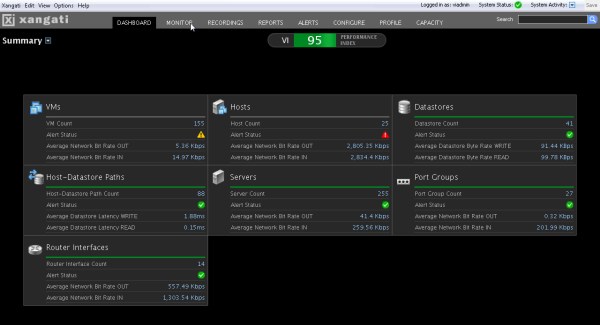
If you have a single vSphere server with local disk, and everyone uses VNC to get into their VMs, then the answer is “you might not need it.” But if you have external dependencies like networks, shared storage, variable load patterns, multiple VI admins creating and provisioning and resizing VMs without your blessing, or (gasp) VDI, you owe it to yourself to give XMD a look. You may make up the costs of deployment during your trial.

One thing vCenter doesn’t necessarily show you, for example, is bursts or storms of resource demand. Anyone who’s ever set up Cacti or MRTG or the like for metrics has found that bursty traffic definitely shows up on user experience, but most practical metrics tools will even out the peaks and you find yourself telling your end user “we’re only seeing 50 IOPs” when that twenty seconds of 500 IOPs may have been causing a serious impact. Or worse, you find yourself passing that trouble ticket off to the storage guys who see the same, and they tell you and your user two days later. Meanwhile, the problem still happens, and you’ve got a grumpier user.

Xangati focuses on fine-grained and broad measurements across your virtualization platform. And even better, they can tie together those bursts to help you find what’s cause and effect, and what’s just the result of troublesome trends in your environment. You can start from the Dashboard and find anything that their software has detected as out of the ordinary, and see the general pulse of your monitored environment as well.

You’ll also be able to dig into linked issues, linked metrics, and look at the measurements immediately surrounding an alert or issue. Maybe the first thing you saw wasn’t the cause, but just a slow decaying effect. XMD will help you track that down even if the issue (or the machine) is gone. Sure, it doesn’t have the 90s retro feeling of just having zoom in/zoom out on a graph, but you’ll get over the loss of greybeard cred when your NOC doesn’t call you as often.

Do These Pants Make My VM Look Too Small?
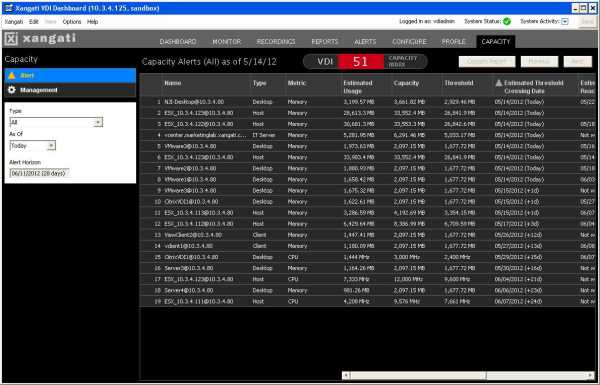
If you’re the only VI admin in your environment, and you provision all the VMs and storage, you’re probably tired by now. But you probably have a firm grasp on what your environment looks like and where it’s growing and going.

More likely though, you have a few people adding, reconfiguring, and removing VMs, storage, and maybe even network links or cluster nodes. And it’s not inconceivable that you have a spreadsheet somewhere tracking what’s where. Hopefully you’re keeping enough detail to know how fast your datastores are growing, how much of your network links are utilized, and how far in advance you need to boost your environment to avoid affecting users and products. No? Didn’t think so.

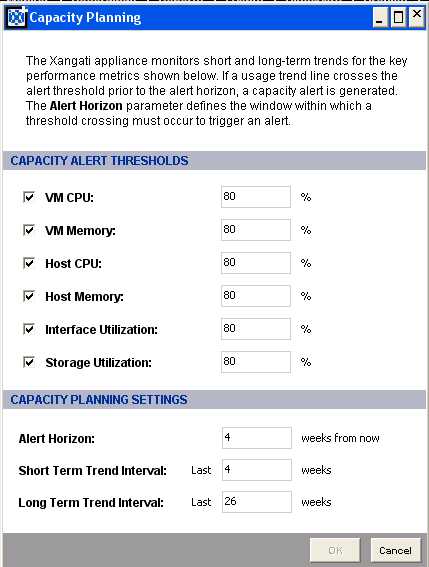
The new feature that really jumped out at me from the latest Xangati demo was their new capacity planning feature. This is already a very useful feature for a first iteration of the component, and you don’t pay anything extra for it once you’ve got the XMD in place and licensed. You set your thresholds of concern (maybe based on hardware acquisition turnaround time, comfort level, or how fast you expect Double Space or Stacker to kick in on your storage server), and XMD watches capacity, utilization, and basic trending for the resources.

For now, as you see in the screen shot above, the focus is on objects. You can see a particular resource and metric and see status of that pairing on a per-day basis. This won’t save you from the 2:30pm “let’s fill up all the VM disks” party that your favorite developer with root access decides to do, but as code creep, log bloat, and memory leaks work their way into your nightmares, XMD will warn you and give you some time to address the issue. They’re already planning to do capacity monitoring on a cluster or resource pool basis, as I recall, so it will become an even stronger tool in your arsenal in the future.

One item I discussed with Xangati as future improvements on this feature is what I’ll call trend trending. Look at line 15 in the chart above. Now back at me. Now back at line 15. I’m not on a horse. But line 15, a virtual desktop, sees increasing CPU usage and XMD tells us we have 15 days at current trend before we cross our 80% threshold (set in the dialog box at left). At the edge of the screen we see that we’ll probably reach 100% capacity on June 7th, about a week later.

Let’s pretend that’s storage utilization instead, just for the sake of argument. What happens if something changes drastically, say, Thursday night. Instead of that gradual growth of your log files and core dumps aiming for 15 days from now, the developers add a new feature that dumps core every 15 minutes, and we  find ourselves looking at threshold in 3 days, or worse, 100% capacity in 7 days. I’d like to see some advanced (and probably optional/granular) trend monitoring so that I’d get a special notification saying “not only are you going down, son, you’re going down faster than you were yesterday.”

I’d be more interested in storage/memory/network utilization on guests, and cpu/memory on hosts. If you’re overprovisioning your VDI resources, you may want more frequent info since one user discovering bittorrent or bitcoin can cause some pain (if you don’t have them blocked).

So where do we go from here?

I’ve only really touched on one feature of XMD, but it’s the one that means the most to me at the moment. If you’re in a VDI environment, you owe it to yourself to talk to Xangati or just get a demo set up with them. I’m not in a VDI environment, so I can’t speak to it very well, although I’ve seen that you get at least as much benefit as you do in the VI environment, but with more potential direct impact on your users in realtime.

As I get my instance of the VI Dashboard going, I’ll probably revisit the capacity planning as well as the other features, and I may get around to some of my other notes as well before the next release. But what’s coming next from Xangati, and what am I hoping for?

First of all, they’re already working on doubling their scaling to support more vCenters. More frequent trend updates for the capacity management piece, live analysis connecting to capacity management, and customizable dashboards across the product are all expected in upcoming releases, as well as more integration and interaction at the hardware level.

And, as much as I’d been hoping for XenServer integration, I am happy to see that Xangati are branching out to a second hypervisor, although it is in the form of Microsoft’s Hyper-V. You’ll see some special value from XMD in the Hyper-V world especially around storage visibility, and those of you with Technet or MAPS access will be able to test this out under existing license without the wonderful 60-day lab reinstall that VMware blesses us with.

Beyond the above, I’m hoping to see improvements in alert sensitivity and trend tracking/alerting on the capacity piece as well, although they’re not firmly carved into the roadmap yet. And I’d really love to see XenServer integration–Xangati has a good relationship with Citrix on the VDI side, so hopefully this will lead to hypervisor synergy as well.

Bonus: Come meet Xangati and Tegile and Hotlink (Oh My!)

By the way, if you’re in the San Francisco Bay Area, you can come meet Xangati (and Tegile and Hotlink) at this week’s BayLISA meeting in Mountain View. It’s free to attend (although we do ask you to RSVP so we can plan pizza and seating) and you’ll get to see a live demo of the freshest XMD around. See details at the previous link, and come join us Thursday night. As another disclaimer, I’m somewhat in charge of BayLISA these days, so it makes me feel good to see a full room, but I don’t get anything tangble if more people show up–more likely I get *less* pizza–but it’s worth it.

Credits and Disclaimer

I would like to thank Xangati for providing the screen shots in this entry… my lab isn’t quite up to providing useful trends yet, although it will be soon.

They have also provided me with a NFR/lab license for XMD which I appreciate, and am looking forward to warming up soon. However, you can test out everything I’ll be working on with the free trial (for vCenter) and the free single-server vSphere edition.

My thoughts in this piece (and in general) are not based on a free license, they’re based on what I find interesting and useful. If I weren’t excited about this technology, I would have left it to others to shout about.

[1] Most likely unrelated to the artist behind the True Blood comics and other IDW classics. And he probably gets enough Poco and “Your Mama Don’t Dance” jokes already, so I’ll spare him those for now.

Some Related Links…

Here are some write-ups on Xangati from Virtualization Field Day 2 in February:

And here are some more recent pieces around the launch:

Let me know what you think in the comments below!

rsts11: Laptop memory – above and beyond!

Ever buy a spiffy new laptop, and then a few months later see that everyone else is buying laptops that take TWICE as much RAM as yours? Too late for buyer’s remorse or a return… but you can’t justify another thousand dollars for another new laptop?

I’ve been in that position twice… once with a laptop I’ve had for 4 years now, and one that’s coming up on 1 year.

UPDATE: I just remembered a third time when I managed a lucky super-upgrade to a laptop… that’s added now.

Inspiron 8200 with 2GB RAM. Pretty good for 2002 tech!

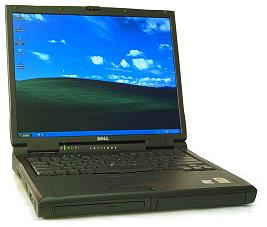
Back in 2001 or so I bought a Dell Inspiron 8200. This was a Pentium 4 Mobile based machine of the same design as the Latitude C840, about with a 1600×1200 15″ lcd, the C-series batteries (one dedicated battery bay, one battery/optical/zip/floppy/hard disk bay), one fixed (but upgradable) optical bay on the side, and a maximum of 1GB RAM. Or so I thought. Now to be honest, I sold the 8200 back in 2003, but later restocked with a short stack of Latitude C840s, which were the business spin of the same machine.
Recently when pulling one of my C840s out, I thought “I have some 1GB DDR SODIMMs. Why not try?” Turns out, while it takes longer to POST now, the C840 readily supports 2x1GB PC2700/PC3200 DIMMs for a total of 2GB RAM. You may find these sticks on close-out at consumer electronics stores… I bought out the closeout stock at 2-3 local Best Buy stores last fall.

The 8200 is still a very viable UNIX laptop, and runs XP or Windows 7 respectably if you keep it clean (I wouldn’t put Creative Suite or Mathematica on it). The docks, including one with a PCI slot, are easily available online, and while you might not want to carry it on trips with you, it’s very convenient for basic computing needs even 10 years later.

Latitude D830 with 8GB RAM? Yup.


I bought a Dell Latitude D830 with a corporate discount two jobs ago. It was as close to top-of-the-line as I could get with all the features I wanted. I’m a screen real estate addict… yes, I’m looking down my nose at your 1920×1080 display, over the top of my 1920×1200 display. Sure, it’s only 12% difference but it matters to me. I think this D830 had the second highest speed Core 2 Duo mobile chip available at the time, dedicated 256MB or 512MB video card, DVD burner, and 1920×1200 display. Three years of Complete Care and corporate-grade in-house service contract, which ended up helping at one point when the power subsystem started failing to charge, and one of my favorite features of some Dell and one Apple model–hot-pluggable modular bay batteries.

Power To The People!

My Powerbook “Pismo” had the option for two batteries, and if both batteries died and you had a third with a charge, you could close your lid, the computer would sleep, you could put another battery in and open it up and keep going. So of course I had three or four batteries. Dell has had a couple of models that supported modular bay batteries, from the Latitude C840/Inspiron 8200 (and I believe earlier C800/820 and I8000/8100) to the D800/830 line. Excellent feature, since I’m more likely to have use for an extra 2-2.5 hrs of battery life than a dvd burner on trips and in meetings/conferences. 

I bought the D830 with 2GB of RAM, knowing I could upgrade to 4GB more cheaply through Amazon or Fry’s or Crucial, than buying it pre-installed from Dell. So I did so, and bumped the hard drive up aftermarket as well.

Within less than a year came the Latitude E-series, very sleek, brushed metal case, and 8GB max RAM. I found threads like this one suggesting that BIOS rev A14 would support 4GB dimms.

The 5300, 6400, and 6500 as I recall all supported 8GB RAM on the same Core 2 Duo chips and chipsets, but when I asked my Dell rep about 8GB on my D830, he said “no dice.” So I quietly ordered the appropriate Dell part anyway, and when it arrived, I updated my BIOS and installed it. It worked, of course. I ordered another stick, and have been rocking 8GB in my D830 (with a variety of disk choices) for the last 3 1/2 years.

Sony VPCF22KFX/B with 16GB of RAM? Whoa!

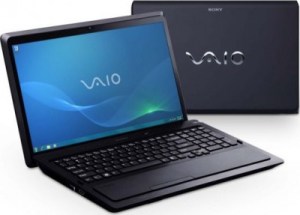
Fast forward to last summer. I changed jobs, got a vacation payout, and found a Sony Vaio VPCF22KFX/B laptop on near-closeout sale at Fry’s. You can still find it at the preceding link for about $1k from Amazon (and if you buy it through my link I’ll be grateful of course), but I paid about $800 for it as memory serves. It came with a 500gb 5400rpm disk, 4GB of RAM, and the i7-2630QM processor — 4 cores, 8 threads, turbo, hyper threading, the typical power features. I bumped it up to 8GB of Patriot RAM, and a 500GB Momentus XT hard drive (500GB spinning disk with 4GB of SLC flash memory in front of it). It’s been working okay for me for the most part, but I started getting random BSODs, and in one night last week I found myself meeting over half a dozen STOP codes I’d never seen before, and a couple I had.

I did not want to believe that the laptop itself was dying, even though I have another 2 months of warranty left. So I pulled the memory and went back to the original Samsung 2GB sticks that came with it. Still got a crash every 3-5 minutes. Pulled the disk and put the original disk in, and other than having 100+ Windows Updates to execute, it worked fine. In fact, it survived three rounds of Windows Updates and three rounds of Vaio Updates. So I put the 8GB kit back in, and it was happy still.

But then I got to thinking… I’ve seen some Sandy Bridge laptops listed with 16GB, and Simon Gallagher (of vTARDIS fame) mentioned 16GB in his Macbook Pro last December. I’ve been waiting for the new Air-y Macbooks to come out hoping for 16GB capacity and a 1920px widescreen, but they’re not out yet and I was impatient. Saw a $110 16GB kit from Corsair, the CMSO16GX3M2A1333C9 to be precise, in the weekly Fry’s ad. It’s also $110 from Amazon but I hadn’t been in to Fry’s in almost 24 hours, so… I picked it up, brought it home, went to the little one’s Glee recital, and came home for a nap. After dinner, I started in on the upgrade project, slow and steady.

First step was a single 8GB dimm. I know the machine works with 8GB total, but will it handle a single 8GB dimm? Yup.

Next step, 8GB plus 4GB. Little bit risky, as the 4GB is slower than the 8GB and is the second stick. But it seemed okay with that. So, next step is obvious.

Yeah, I was thirsty. And Coca Cola has not paid me for their mention here, although if they wanted to send me a fully stocked vending machine for my store, I wouldn’t turn it down.

There we go. 16GB RAM, and it seems to be running pretty stably.

I still need to find the issue with the Momentus XT, and figure out a better disk option for this machine. I have some 60GB Pyro SSDs but I haven’t quite gotten the hang of a small internal disk on a laptop yet. So I may shell out for a 120GB SSD with rebate, or just bump up to a 500 or 640 GB 7200 spinning disk. The D830 is working well with a 640GB Caviar Blue drive, and I have a 48GB ExpressCard that I could use for high performance supplemental storage.

rsts11: Silicon Valley VMUG UC, and Storage Field Day

Quick thoughts on the SVVMUG Conference

I survived the Silicon Valley VMUG (VMware User Group) conference event on Wednesday. It was an interesting mix of educational and informative presentations, and vendor exposure and conversations. I have some thoughts to write on later… including a grand unifying theory of tech conferences (that will require a bit of graphic work)… but I thought I should put a note out there to thank the organizers for making an excellent event for the 500+ of us who registered, most of whom seem to have shown up (as I did).

I also thought I’d mention the VMUG Advantage membership option, which I only learned about the day before. You can get a free VMUG membership, and associate with your local VMUG if one exists, at http://www.vmug.com. This will likely qualify you for any local events like this week’s Silicon Valley conference, and give you access to the local VMUG community.

If you’re looking at using classroom training or certification testing from VMware, going to VMworld, or purchasing a license for Workstation 8 or Fusion 4, look into VMUG Advantage. For $200 a year (or less with a discount code), you get access to a wide range of eLearning courses, 20% off on classroom instruction, 20% off one certification exam a year, $100 off VMworld registration, and a 30% discount on one of the desktop virtualization products per year.

(I believe you can choose Workstation or Fusion, and not both, for this discount… however, if you’re on VMware’s marketing mailing list, you will probably see a 15-30% discount on Workstation every few month, and I’ve seen 20-40% discounts on Fusion in the same mailings.)

By the way, I attended this event as a free member of the local VMUG, and while I received free lunch and coffee/soda, these considerations did not impact my opinions of the sponsors.

Oh look, Storage Field Day

I’m also pleased to report that I’ve been invited to be a delegate[1] to the first Storage Field Day later this month in Silicon Valley. Looking forward to seeing Robin Harris and The Other Scott Lowe again, and meeting more independent thinkers on storage for the first time. There will be a couple of familiar names on the other side of the blogger “dragon’s den” tables as well, including PureStorage and Coraid, and some folks I haven’t been all that formally introduced to, such as Nimbus Data and Tintri (the latter I actually met Wednesday at the VMUG).

Early in my career I did a fair bit of storage work, and much as going to work for Nortel pushed me into networking, going to work for 3PAR pushed me even further into storage technology. I’ve done a range of implementations since then, from what was more SPOD than JBOD (i.e. “steaming pile”, or at least overstacked pile), to conventional Engenio and EMC and 3PAR, so it will be particularly intriguing to come up to speed on what’s closer to the bleeding edge, or at least the warm and shiny edge… and have a feel for what’s coming in advance.

I expect that my “deep generalist” nature is a benefit that I bring to the Tech Field Day events. There are a lot of people there who are waders-deep in the specific topic, and I may learn as much from the other delegates as I do from the presenters and sponsors, but by being ankles deep in almost everything (except sales… whew…) I can offer a valuable perspective and maybe ask a question that wouldn’t be obvious to someone who lived the specific flavor of technology 24/7. Like why there’s a Rick Roll easter egg[2] in the new vSphere Client.

So I’m looking forward to the Storage Field Day experience on April 26-27, and the “bonus” Solid State Storage Symposium on April 25. You can probably still get a ticket to SSSS if you’re gong to be near San Jose, California on April 25, and you should be able to see most of the presentations all three days via online streaming at techfieldday.com. You can also keep an eye on realtime conversations on Twitter on the hashtags #SFD1 and #techfieldday.

[1] As with all Tech Field Day events, the sponsors and presenters will be providing for my lodging, meals, and entertainment during the event. They may also provide gifts or promotional items. We definitely appreciate their support for these events. However, as Tech Field Day delegates, we’re not beholden to the presenters as far as content and perspective (or even reporting/blogging at all) . You’ll hear what each of us thinks, from our own perspectives, if we think it’s worth writing or talking about.

[2] I hope you didn’t look too long for the easter egg… I’m just making that up.

rsts11: Fun with Verizon phones and vehicle navigation mounts

I bought a DROID BIONIC phone about 6 months ago, and got the Verizon/Motorola cobranded vehicle mount. Turns out that the Verizon-branded mount includes a long 1/8″ to 1/8″ audio cable, as well as the original Motorola user guide that illustrates the cool 2x850mA car charger, and which talks about a custom USB cable that lets you run audio out of the dock to your car stereo aux input.

You see what they did there?

Yup, no car power adapter, and no USB cable at all.

Mind you, you can use any micro-USB charger with the dock, and it will help to charge your phone as long as you’re not really using it in the car. But if you want enough power to keep up with GPS or data or music, you’re out of luck.

I returned the Verizon-branded mount and found the Motorola original package at Fry’s (for about $10 more) and have been using it ever since.

I recently upgraded to the DROID RAZR MAXX, a brilliant phone with amazing battery life. I’m getting twice the battery life on RAZR MAXX with mostly stock settings and data/GPS always on, than I did on BIONIC with extended battery and Juice Defender running. Yep, *twice* the life, as in nearly two full days.

The store I ordered my phone from sold me a RAZR mount, and I didn’t look very closely since I figured they knew what they were doing, and going through a lot of effort to order my RAZR MAXX. It also made some sense to me that they might have a unified mount with variable inserts to fit the different phones. But when the MAXX showed up, it didn’t work with or without the insert. So I returned the RAZR mount, and ordered the RAZR MAXX mount.

Guess what didn’t come with the Verizon/Motorola co-branded version of the RAZR MAXX mount?

Yuuup. For those of you keeping score, it’s a Motorola P617 or SPN5581A dual-USB 12V cigar plug charger, and an SKN6394A USB and audio cable. You can find the P617 on Amazon for about $19, and it’s currently even eligible for Amazon Prime shipping.  It seems you can’t find the SKN6394A anywhere *except* in the Motorola original mount kits for the DROID BIONIC, DROID RAZR, DROID RAZR MAXX, and I think the DROID 3 and DROID 4 but I’m not sure about those.

As annoyed as I am, I’m going to keep the inferior mount kit after all. For one, I get a much better corporate discount from Verizon than from Amazon… and since I’ll be giving the BIONIC to my significant other, and she doesn’t believe in car mounts (and doesn’t have a 1/8″ aux input on her car stereo anyway)… if I keep the charger and audio/usb cable, we’ll all be happy.

But if you’re getting a cutting-edge DROID phone from Verizon, by all means get screen protectors, a home charger, HDMI dock, lapdock if you’re so inclined… but skip the vehicle mount and go to Motorola or Amazon and get the real deal.

As the links below will warn you, don’t lose that custom USB cable. Apparently you can’t buy it separately anymore (or at least Motorola doesn’t list it)… and I’m not seeing them on eBay yet either.

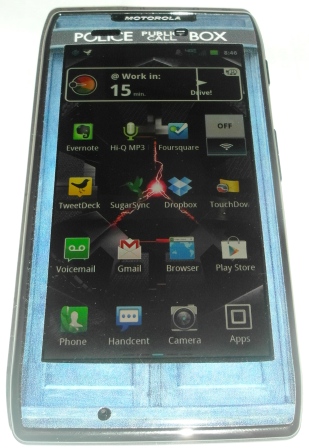
And as a side note, the spiffy skin for the phone was actually discovered through a Facebook ad for custom phone skins. They offer skins for many devices, including iDevices, Kindle Fire, and the DROIDs I have. Good prices, fairly quick shipping (for a custom product), and since my phone is Kevlar-enhanced I don’t feel the need for a ZAGG for this device. So it works pretty well. See the other patterns they have at this link, courtesy of site:customphoneskins.com in the Google search bar.

And as a disclaimer, I received no special consideration from any of the companies or brands mentioned above in relation to this rant.


Resources:

http://www.motoask.com/motorola-atrix-4g-general-discussion-f12/one-of-the-most-requests-part-number-for-atrix-vehicle-dock-t651.html

http://forums.androidcentral.com/razr-accessories/146016-audio-car-charging-cable-navigation-dock.html