Splash Mountain Syndrome – It’s not what you think

A couple months ago my friend Christopher asked his friends about getting comfortable with public speaking. I’ve told this story to small crowds from time to time, but never put it all out there… so here is how I contracted Splash Mountain Syndrome, and what it meant to my public speaking career.

Most of my readers are familiar with Impostor Syndrome, where you doubt you’re good enough to do your job or tell your story, or that there must be someone better out there. Most if not all of us in tech have dealt with this at one time or another, feeling like the turtle on the fencepost.

Image via https://commons.wikimedia.org/wiki/File:Splash_Mountain_at_Disneyland.JPG (This file is licensed under the Creative Commons Attribution-Share Alike 3.0 Unported license.)

We’re going to Disneyland

Well, to explain what I experienced in my speaking career at Cisco, we have to go back to spring 2003. I was between jobs, and had gone down to Southern California to spend a weekend with a lady I was interested in. We went to the grand opening of Amoeba Records Hollywood, and also made my first trip to Disneyland.

She stood in line for nearly an hour with me for the Winnie the Pooh ride, so when she wanted to go on Splash Mountain, I figured I shouldn’t start letting her down quite so early in the relationship. So we went to Splash Mountain. The line was faster there for some reason.

As we went up on the ride to the top, I wondered if it was too late to back out. Maybe hop out at the basketball court and walk down, and probably get kicked out of the park. As we got closer to the mouth of the mountain, it became clear that I had no option but to hold on for dear life and deal with it. And as we emerged into the light, my legs clamped on the log car, I closed my eyes, and dropped.

As we walked away, I asked my companion if she’d heard a noise like a small rodent being strangled. “Yes,” she said. “That was you.”

How this applies to public speaking

I can say that it was more distance than drop ride disappointment that kept that from being a long term relationship, but similar feelings happened almost every time I got ready to travel for a speaking engagement.

I’d be eager to sign up for an event, whether a partner conference or partner sales event, Strata+Hadoop World, or Cisco Live. But the closer it got, even if I already had my presentation pretty much committed to memory, I’d start to think I made a terrible mistake, that I would dread the whole trip, that I’d get my first heckler, or that I should just let someone in marketing handle it.

The dread would intensify as I was packing, probably because even after six years of work travel, I still sucked at packing efficiently (I’m still not that great, despite lots of YouTube videos). But I’d still finish up the packing, with a laptop bag heavier than my clothing and coffee bag, and head off to Seattle or Atlanta or Manhattan or Las Vegas or Denver or wherever.

Of course, I’d do fine, entertain people with the fairly unique mix of facts, experience, humor, cultural references, and sarcasm that I became known for, and get good feedback afterward. We’d find a good restaurant for dinner, and then move on to the next adventure.

But the next time a trip came up, I’d go through the same cycle. At least I didn’t make the noise again.

As Martha Stewart would say, it’s a good thing

I think it was a good thing. I’ve seen speakers who are way too comfortable and lose their edge, their connection with the audience, or even their talk track. We’ve all been in sessions where the speaker is there because of title and clout rather than their scintillating message and delivery; I wonder how many of those people have lost Splash Mountain.

Splash Mountain Syndrome helped keep me on my toes, and definitely made sure that I didn’t get so comfortable with my content that I went into autopilot and lost audiences and credibility. It still led to an uncomfortable hour or more leading up to my trips, but I came out of it stronger and more confident.

Have you experienced anything like Splash Mountain Syndrome? Have any tips for people preparing for pulbic speaking? Share in the comments if you’d be so kind.

Crowdfunding Hits, Misses, and Lessons Learned

Back in November 2020, I wrote about some considerations and dramatics around crowdfunding campaigns. In this post, I’ll give you my top five and bottom five crowdfunding efforts, and maybe a lesson or two to take to the future.

This post has been sitting in my draft folder for a year now, but nothing has changed in it other than the recent time references, which I’ve left as they were in November 2020. I’ll come back with photos later, rather than putting this post off another year.

It was the best of times

My first crowdfunding campaign was the LunaTik and TikTok wrist cases for Apple’s 6th generation iPod Nano (the square one). MINIMAL Design came out with the first huge campaign in 2010, with over $942,000 in backers and a super high quality product that was delivered reasonably. My red LunaTik still sits on my desk, with a functional PRODUCT(RED) Nano in it, and a couple of years ago Scott Wilson, the founder of MINIMAL, mentioned that Apple had used his band/case as part of the prototype design and testing for the original Apple Watch. The watch has come a long way, but the product is still beautiful and functional ten years later. And they’ve come out with more products for the real Apple Watch since then.

Continue reading

Thirty Days On The Front Lines: A return to tech support

In September 1996, I left my desk at IQuest Internet in Indianapolis for the last time. A friend from the MUDs I was on had talked me into talking to her brother, a recruiter at Taos Mountain Software, and two weeks later I had an offer, notice given for my apartment and my job, and the terrifying thought of driving 2300 miles with my possessions in a Ryder truck, my very unhappy cat in the front of the truck, and my Pontiac Grand Prix on a trailer it was too heavy for.

But on the flip side, I was getting out of the Midwest and its glorious winters, escaping a salaried position that ended up being a pay cut, and most importantly, leaving behind end-user tech support. For the next 25 years or so, I did tech support, and infrastructure/architecture/caffeine delivery systems, but for internal colleagues who were generally more aligned with my assigned priorities.

Now, I’ve gone back onto the front lines, supporting end users from around the world in several different languages (thanks to Google Translate or Bing Translate), explaining and troubleshooting and answering questions about cryptocurrency in general, Ethereum and Chia in particular, and specifically how to make them work with one of the more advanced mining pools.

As I told the owner when I started, I’ll scale back or even hand over the reigns altogether when I find something more in line with Silicon Valley expense levels, but for now, it’s an extension of what I’d been doing on Telegram since January, and it’s supplementing my coffers in the process.

I meant to write this last month, when it would have been 30 days, but the conversations get overwhelming and blog posts get distracted-from, so here we are closer to 60 days in reality.

What’s it like working for a mining pool?

Continue reading

When your corporate message is 15 years too late

This is a fun little gripe, not a particularly deep reflection on anything.

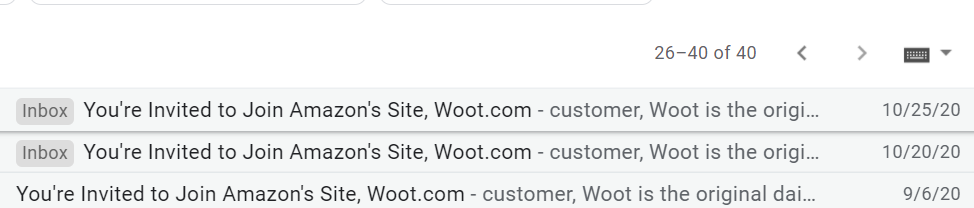
I recently dug back into my email to find the following gem:

As you can see, I’m coming up on 15 years (at least) as a customer of Woot!, the daily deal and “bag o’ crap” seller of geek fame. I’ve been a customer long enough to remember moofi, and I’m pretty sure I remember them having just one deal a day.

Well, Amazon acquired Woot! in 2010, and it’s kinda folded in nicely since then. You can log in and pay with Amazon, and Amazon Prime shoppers get Prime shipping and occasional benefits (like a $5 discount on the already marked down Woot! version of this 100-pack of Peets Nespresso-compatible capsules, which are $62 on Amazon but $39 on a recent day’s Woot! deals).

But somehow the marketing email side of Amazon doesn’t realize they have customers who are already customers of Woot!, because 40 times since 2014 (most of them in the last year), they’ve sent me an invitation to join Woot!.

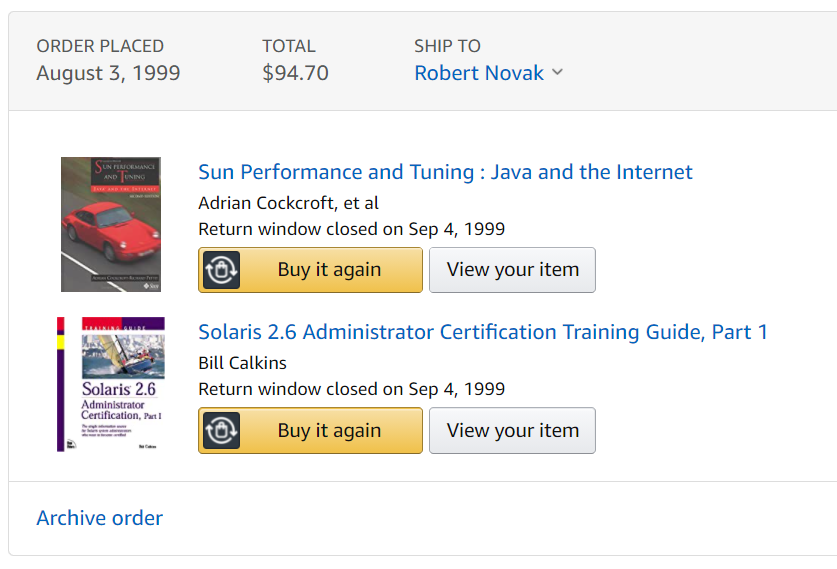
Now before the Amazon login integration, I could understand it. After all, my Woot and Amazon accounts are under different email addresses, in part because when I started shopping with Amazon in 1999, Gmail didn’t exist.

Darn, I don’t need that Solaris 2.6 guide anymore, and the return window has closed.

Anyway, it’s things like this, and getting ads in my mobile games for other games I already have (even the game I found that mobile game through), that make me feel that AI isn’t quite all it’s feared to be just yet.

And I’m a bit disappointed that they haven’t offered me a new customer promo code in each of those 40 emails. That would be a LOT of deeply discounted coffee capsules and cast iron grill accessories, and maybe, just maybe, my first-ever Bag O Crap.

Where do we go from here?

Well, a new Woot email just came in, so I’m going to go look at what I don’t need from this week’s deals.

Robert’s Rules for Success, or at least reduced chance of failure

I’ve made a few references lately to avoiding Jurassic failures. In some tech circles, including cryptocurrency projects, it seems very popular to make bad decisions and not claim responsibility. And yes, I’ve been writing and talking and thinking a lot about crypto this year. I’m not alone, but I’m the only one on this blog who you’d be able to make that observation about.

The Jurassic reference of course is to Jeff Goldblum’s character Dr Ian Malcolm in Jurassic Park.

Your scientists were so preoccupied with whether or not they could, they didn’t stop to think if they should.

The Jurassic Park reference is a bit more universal than the one I used to use, which was to Wangdi something. I had a Nepalese classmate in college named Wangdi, and the main thing I remember of him from those years was his disc soccer/disc golf prowess. Well, that, and the time he had someone spread three soccer discs in a throw which he would normally have caught with ease, but in this case he tripped over a sprinkler head about two steps into his run and faceplanted in the quad.

  1. Don’t always do things just because you can

    Corollary: Don’t always do things just because you saw them on the Internet

2. Don’t try to start out at full speed; watch where you’re going and work your way up

Corollary: Set a reasonable plan and try to follow it. Don’t get distracted by squirrels

3. Plan to spend at least one minute for every $100 spent, learning how your item works

Corollary: If you can’t do that, don’t expect others to do it for you for free

Between these two warnings, you can take something away. First, don’t always do things just because you can (or because you saw them on the Internet). Second, don’t try to start out at full speed; watch where you’re going and work your way up.

And third is my One Percent Rule, not to be confused with Arthur Conan Doyle’s Seven Percent Solution. For every $100 you spend on an endeavour, spend at least one (1) minute learning or trying to understand it on your own before demanding help in free volunteer forums or from overworked support staff. So if you’re spending $3,000 on a GPU, but you’re not willing to spend 30 minutes learning how to use it, maybe don’t spend it. See also the first and second rules above.

Continue reading