The Awesome Power of a Fully Operational Decision-Making Mongoose; or, RASCI as a transitional responsibility model

250px-RASCI[1]I’ll apologize in advance to George Clinton.Video below.

As I prepare to transition out of my current job, my priorities change and I have to be a bit more cautious about what I get involved in, so as to not leave anyone hanging when I do hand over my badge in just over two weeks.

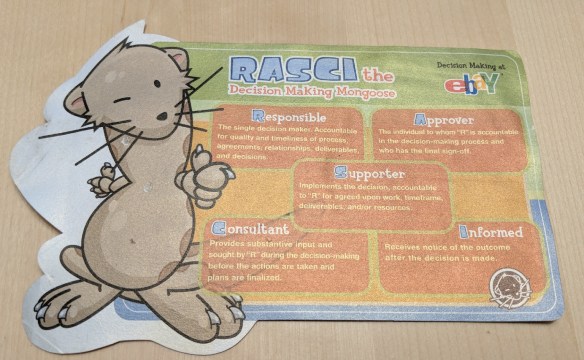
I’m reminded of the decision-making scheme we were taught at eBay–RASCI. That’s

  • Responsible (Person who does the work),
  • Accountable (the person in charge, also Approver of the work R does),
  • Supporting (someone who helps out with the process but is not the main responsible party–sometimes merged into Responsible for RACI),
  • Consulted (subject matter experts who provide advice), and
  • Informed (people who get status updates).

This model was obviously intended to set out expectations and points of responsibility within a project, defining responsibility and telling people who would be on either end of a communications channel as well as who is actually hands-on-keyboards (figuratively or literally) to do the actual work. However, it has another useful role.

At the point where someone gives notice and their countdown begins, they would move into the “C” category. They no longer get action items, presumably no on-call, and the ability to focus on passing along knowledge as needed to the people who would pick up their areas of responsibility.

I’m in the C category now at Disney, There’s a lot to be done, but I can’t take long-term ownership of it anymore. What I can do is work with the folks who are taking over for me, make sure they have the tools and contacts to do their best in my absence.

But what’s this with the mongoose?

Well, that’s controversial. RASCI is the name eBay gave to the mascot for their process, He’s the “decision-making mongoose at eBay.” There was a stuffed version (I have one somewhere in the garage, I’m sure), and it was entertaining and a bit creepy. There was also an unofficial travel blog, with pictures of RASCI in various settings. I can’t find that anymore, but it was out there, I promise.

My fiancee wondered why anyone would need a mascot for decision-making. Fair point, but it does make the model more personally accessible for people who aren’t in project management. And how many mongooses (mongeese?) do you run into in your daily life?

So where do we go from here?

Well, I’m going to Cisco. I don’t know about you guys.

But seriously, RASCI or its variants may be worth considering if you’re having problems with identifying roles in a project, or even if you aren’t yet. You don’t have to use the mongoose, but hey, it’s there.

It’s also worth considering RASCI or the like as a means of communicating a transition of responsibility, whether someone is leaving a project, a department, or the company entirely. Who owns that piece of infrastructure the guy who just left was handling for years? Who remains in the department to provide support and receive reports?

If you have experience with RASCI/RACI, or if you have an extra RASCI doll in need of a new home, let me know in the comments.

And for those of you who might not have known the title reference, have yourself some P.Funk.

[Video link updated 2017-11-30 since the old one has disappeared since 2014.]

[2018-03-02: The card we had to remind us of the RASCI model]

Maker:0x4c,Date:2017-10-14,Ver:4,Lens:Kan03,Act:Lar01,E-YMaker:0x4c,Date:2017-10-14,Ver:4,Lens:Kan03,Act:Lar01,E-Y

FirmwareGate and FCoEgate two months later

I was surprised last week at Interop to hear people still talking about both FCoEgate and HP FirmwareGate. It seems that in the absence of any clarity or resolution, both still bother many in the industry.

For those of you who missed the early February drama (and my relevant blog post):

FCoE-gate

FCoEgate: An analyst group called The Evaluator Group released a “seriously flawed” competitive comparison between an HP/Brocade/FC environment and a Cisco/FCoE environment. Several technical inquiries were answered with confusing evidence that the testers didn’t really know what they were doing.

Several people I talked to at Interop mentioned that this was a perfectly understandable mistake for a newbie analyst, but experienced analysts should have known better. Brocade should have known better as well, but I believe they still stand by the story.

The take-home from this effort is that if you don’t know how to configure a product or technology, and you don’t know how it works, it may not perform optimally in comparison to the one you’re being paid to show off.

This one doesn’t affect me as much personally, but I’ll note that there doesn’t seem to have been a clear resolution of the flaws in this report. Brocade has no reason to pay Evaluator Group to redo a valid comparison, and technologists worth their salt would see through it anyway (as many have). So we have to count on that latter part.

FirmwareGate

https://twitter.com/ProLiant/status/433252908755582976

FirmwareGate: HP’s server division announced that, for the good of their “Customers For Life,” they would stop making server firmware available unless it was “safety and security” updates. How can you tell if it’s “safety and security?” Try to download it.

HP claimed repeatedly that this brings them in line with “industry best practices,” thus defining their “industry” as consisting exclusively of HP and Oracle. I don’t know any working technologists who would go along with that definition.

HP promised clarification on this, and defended their policy change by declaring industry standard x86/x64 servers as equivalent to commercial operating system releases and Cisco routers.

They even had a conversation with my friend John Obeto, wherein they convinced him that nothing had changed. Ah, if only this were true. (It isn’t.)

But I had fleeting faith that maybe they’d fixed the problem. So I went to get the firmware update for a nearly 2-year-old Microserver N40L, which had a critical firmware bug keeping it from installing a couple of current OSes. Turns out it’s not a “safety and security” fix, and my system apparently came with a one year warranty.

So if I wanted to run a current Windows OS, I either have to spend more on the support contract than I did on the server (if I can find the support contract anymore), or go with an aftermarket third party reverse-engineered firmware (which, unlike HP’s offerings actually enhances functionality and adds value).

Or I can go with the option that I suspect I and many other hobbyists, home lab users, influencers, and recommenders will — simply purchase servers by companies that respect their customers.

What should HP be doing instead?

The “industry best practices” HP should be subscribing to include open access to industry standard server firmware that fixes bugs they delivered, not just vaguely declared “safety and security” upgrades, much as every other industry standard server vendor except Oracle does. That includes Dell, Cisco, Supermicro, Fujitsu, NEC, Lenovo/IBM, and probably a number of other smaller players.

As my friend Howard Marks noted, some of us would be satisfied with a software-only or firmware-only support contract. On-site hardware maintenance isn’t necessary or even affordable for many of us. Many of us who buy used servers would be better off buying an extra server for parts, and most of us buying used servers know how to replace a part or swap out a server. Some of us even better than the vendor’s field engineers.

HP has been silent on this matter for over a month now, as far as I can tell. The “Master Technologists” from HP who won’t distinguish an MDS router from an x86 server have gone silent. And I’m sure many of the “customers for life” that the 30-year HP veteran graciously invites to keep buying support contracts will start looking around if there’s not a critical feature in HP servers that they need.

So where do we go from here?

I can no longer advocate HP servers for people with budgets containing fewer than 2 commas, and even for those I’d suggest thinking about what’s next. There are analogous or better options out there from Dell, Cisco, Supermicro, Fujitsu, NEC, Lenovo, and for the smaller lab form factors, Intel, Gigabyte, Shuttle, and others. (It’s also worth noting that most of those also provide fully functional remote management without an extra license cost as well.)

If you do want to go with HP, or if you can’t replace your current homelab investment, there are ways to find firmware out there (as there has been in the past for Sun^wOracle Solaris). It took me about 15 minutes to find the newly-locked-down Microserver firmware, for example. It didn’t even require a torrent. I can’t advocate that path, as there may be legal, ethical, and safety concerns, but it might be better than going without, at least until you can replace your servers.

And I’ve replaced most of my HP servers in the lab with Dell servers. One more to go. If anyone wants to buy a couple of orphaned DL servers in Silicon Valley (maybe for parts), contact me.

If anyone else has seen any clarity or correction in the state of FCoEgate or FirmwareGate in the last month or so, let me know in the comments. I’d love to be wrong.

Three traps to avoid on the Internets

I have gotten into the habit of tweeting every few weeks about some of the most common basic misconceptions on a couple of buzzwords.

1. The plural of ‘anecdote’ is not ‘data.’

The first one still stands. And if you’re wondering, it’s also not ‘big data’ either. Or ‘data science.’

No matter how politically advantageous it may be to extrapolate a small number of observations as “proof” of a hypothesis, it just doesn’t work that way.

As Neil deGrasse Tyson mentions on the new Cosmos, humans are wired to find patterns where there are none. Sometimes, we decide the pattern we want to “prove” and only pay attention to the data that backs up that pattern.

https://twitter.com/MikeLoBurgio/status/445931300352831489/photo/1/large

But if you’re getting ready to use that one study, or those two or three incidents, to express ‘proof’ of your hypothesis… think about whether there are other hypotheses that might be just as valid. Or better yet, go get more data. Very little in this world is cut and dried, other than flowers. And jerky. So don’t be jerky.

2. If you have to tell people you’re disruptive, maybe you’re not.

This one was also a painfully obvious observation for me. If storage vendors say “we put a flash drive in our array, look at us, we’re disruptive” in 2014 (or even 2013), you’re not going to take them seriously.

The term has some value in moderation, but maybe find a less dramatic synonym for “innovative” or “unexpected” next time  you’re writing a blurb.

When you tell me your company, product, CEO, or incredibly attractive animated mascot is “disruptive” I think of a 2 or 3 year old in the middle of the room howling and throwing things around. And I’m the neighbor/friend standing there feeling bad for that kid’s parents who aren’t handling it very well. Is that the image you’ve spent beaucoup bucks trying to cultivate?

3. Give the absurdly long and pointless lists a break

cosmo-listsOkay, I’ll admit this was a stretch. I wrote the headline and had to make the data fit. See what I did there?

I know all the Social Media Gurus say that you have to have long lists of things to get people’s attention. And they each have one anecdote of when that actually worked. But how many of them can really make use of 16 new sex positions, or 173 ways to make your toes really sparkle, or 5,150 unbeatable ways to increase traffic to your website?

Keep the lists to a minimum, and remember that you’re probably far more interested in the list than anyone who might see a retweet of it in the next decade. But on the upside, your list is (probably) clearly anecdotal, so you’re dodging trap #1 above.

So where do we go from here?

Well, first, some of you might not know where that tag comes from. It’s a an old classic I heard on the Dr Demento show decades ago called “Spock On.” The video is below, or you can skip to the pertinent bit here.

(To debunk another classic faux pas… very few of the songs usually attributed to Dr Demento were “sung” or performed by him. He just made many of them famous, including Weird Al Yankovic and Elmo and Patsy. The one you might have actually heard the good Doctor on was his revision of “Shaving Cream”)

And now that your day is brightened a little bit… don’t make your readers step in a big pile of shaving cream (unless you are a disruptive SCaaS provider).

What terms are bugging you these days? I would add “game changer” (which is great if you’re running the boardgame room at a convention) and guru/ninja/rockstar, but I’m hoping for a cheerful and upbeat Friday so I’ll leave my gripes there. Chime in on the comments if you like.

Pope Francis and Devops – On Further Genuflection

devops-everywhere

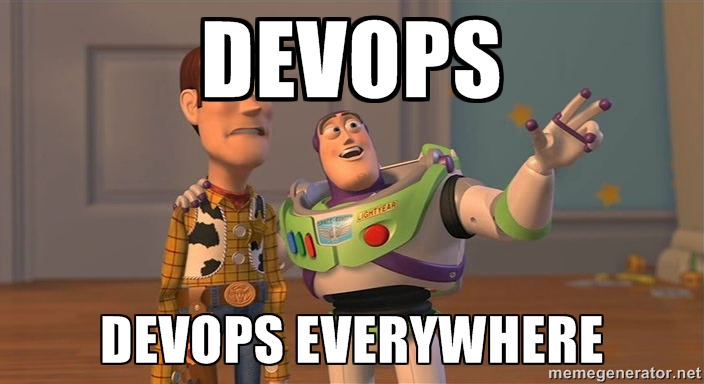
I have long been uncomfortable with the branding of “devops” in what used to be the world of system administration. It’s becoming almost as dynamic and imprecise as the F-word is (just two more parts of speech to go, i think), up there with “cloud” even (someone out there must be proud).

Matt Simmons had a good write-up on his blog about what he called the “worst ideas of the [devops] movement” and I have to agree with his take on that whole matter (except his misspelling of sherbet, which I’m told is now an accepted spelling).

We practicitioners in the sysadmin world are surrounded by marketers, headhunters, and opportunistic writers who latch onto different flavors of the Devops concept. People outside our sphere see the buzz and the branding from us and from this border element as well. When those of us doing the work can’t agree on a message that is clear and accurate without being exclusionary, we do more harm than good.

But this morning, I figured out the core of my objection, while being berated on Twitter by someone who could be considered one of the “high priests” of Devops. What bugs me is the “organized religion” nature of Devops.

nobody-expects-devops

I don’t need people who say “either you’re [a] Devops or your dumb[sic].” I don’t want to trick people into Devopsing. And I don’t feel the need to tie any particular buzzword or brand identity into everything interesting and useful in my industry or profession.

What does Pope Francis have to do with all of this? Well, recently he’s been talking about deeds and actions, rather than branding and dogma, and going a bit gentler than his predecessors on people who are conscientious but not Catholic. My take on that is that it doesn’t devalue the good works and good conscience of a Catholic to acknowledge that you can have good works and a good conscience without being Catholic.

spidey-devops

Now imagine if you could play well with others in a technology setting, be a good sysadmin, and build scalable and sustainable environments… even without calling them, yourself, your department, or your religion Devops. (ps: it’s easy if you try; I was doing that at the turn of the century, although I wouldn’t even label that as hipster devops.)

And imagine if you could acknowledge others doing the same, without having to staple the Devops label on them. It’s true, you’ll risk losing the people who have bought into the upper-case D branding, or people whose managers say “we have to be Devops, take a few devopses and go devops at that devops conference.” You may also confuse HR people who are under fire to hire X number of devopses. But the profession and your environment probably won’t suffer.

If you have to brand, or rebrand, your personal practice for your own reason, go ahead and do it. It’s your business card, after all. But if you feel that building scalable and sustainable environments, working well with your coworkers, and being a good sysadmin require a brand label that is inconsistently defined at best, well, you’ve lost me, and probably at least a few other sysadmins.

Disclaimer: I used to be Catholic, still believe in the one true spelling of sherbet, and claim fair use on the Toy Story picture above, which obviously is not owned by me.

One Size Fits All: Hyper-V on VMware turf, custard trucks, and IT evangelism

At VMworld 2013 in San Francisco, there was a lot of buzz around Hyper-V, oddly enough. A few vendors mentioned multi-hypervisor heterogeneous cloud technologies in hushed tones, more than a few attendees bemoaned the very recent death of Microsoft TechNet Subscription offerings, and guess who showed up with a frozen custard truck?

8015.Custard_picks

Yep, Microsoft’s server team showed up, rented out and re-skinned a Frozen Kuhsterd food truck, and handed out free frozen custard for a chance to promote and discuss their own virtualization platform and new publicity initiative, branded Virtualization2.

The frozen custard was pretty tasty. Well worth the 3 block walk from Moscone. It was a pretty effective way to get attention and mindshare as well–several people I spoke with were impressed with the marketing novelty and the reminder that VMware isn’t the only player in the game, even if one friend considered it an utter failure due to the insufficient description of frozen custard.

Almost two years ago when I did my Virtualization Field Day experience, the question I asked (and vendors were usually prepared to answer) was “when will you support Xen in addition to VMware?” This year, it’s more “when will you support Hyper-V?” So a lot of people are taking Microsoft seriously in the visualization market these days.

Insert Foot, Pull Trigger

One nominal advantage Microsoft has had over VMware in the last few years is an affordable way for IT professionals to evaluate their offerings for more than two months at a time. But first, some history.

time-bomb-meme

Once upon a time, VMware had a program called the VMTN (VMware Technology Network) Subscription. For about $300 a year, you got extended use licenses for VMware’s products, for non-production use. No 60-day time bomb, no 6-reinstalls-a-year for the home lab, and you can focus on learning and maybe even mastering the technology.

Well, in February 2007, VMware did away with the VMTN subscription. You can still see the promo/signup page on their site but you’re not going to be able to sign up for it today.

At that point, Microsoft had the advantage in that their TechNet Subscription program gave you a similar option. For about $300/year you could get non-production licenses for most Microsoft products, including servers and virtualization. I would believe that a few people found it easier to test and develop their skills in that environment, rather than in the “oops, it’s an odd month, better reinstall the lab from scratch” environment that VMware provided.

Well, as of today, September 1, the TechNet Subscription is no more. If you signed up or renewed by the end of August 31, you get one more year and then your licenses are no longer valid. If you wanted some fresh lab license love today, you’re out of luck.

Technically, you can get an MSDN subscription for several thousand dollars and have the same level of access. The Operating Systems level is “only” $699 (want other servers? You’re looking at $1199 to $6119). Or if you qualify for the Microsoft Partner Program as an IT solutions provider, you can use the Action Pack Solution Provider to get access to whatever is current in the Microsoft portfolio for about $300/year. But the latter is tricky in that you need to be a solutions provider and jump through hoops, and the former is tricky because you might not have several thousand dollars to send to Redmond every year.

Help me, Obi-Wan vExpert, you’re my only hope

In 2011, Mike Laverick started a campaign to reinstate the VMTN subscription program. The thread on the VMware communities forum is occasionally active even two years later. But after two years of increasing community demand and non-existent corporate support, a light appeared at the end of the tunnel last week at VMworld in San Francisco.

As Chris Wahl reported, Raghu Raghuram, VMware Executive Vice President of Cloud Infrastructure and Management, said the chances of a subscription program returning are “very high.” Chris notes that there’s not much detail beyond this glimmer of hope, but it’s more hope than we’ve had for most of the last 6 years. For those of you who remember Doctor Who between 1989 and 2005, yeah, it’s like that.

Today, your choices for a sustainable lab environment include being chosen as a vExpert (or possibly a Microsoft MVP–not as familiar with that program’s somatic components) with the ensuing NFR/eval licenses; working for a company that can get you non-expiring licenses; unseemly licensing workaround methods we won’t go into; or simply not having a sustainable lab environment.

I added my voice to the VMTN campaign quite a while ago. When nothing came of that campaign, and I found myself more engaged in the community, I applied for (and was chosen for) vExpert status. So the lab fulcrum in my environment definitely tilts toward the folks in Palo Alto, not Redmond.

But I did mention to the nice young lady handing out tee shirts at the Microsoft Custard Truck that I’d be far more likely to develop my Hyper-V skills if something like TechNet subscription came back. She noted this on her feedback notebook, so I feel I’ve done my part. And I did get a very comfy tee shirt from her.

When I got back to my hotel, I found that the XL shirt I’d asked for was actually a L. Had I not been eating lightly and walking way too much, it wouldn’t have come anywhere near fitting, and it probably won’t any more, now that I’m back to normal patterns. But maybe that size swap was an analogy for a bigger story.

One size doesn’t fit all.

If Microsoft and VMware can’t make something happen to help the new crop of IT professionals cut their teeth on those products, they’ll find the new technologists working with other products. KVM is picking up speed in the market, Xenserver is moving faster toward the free market (and now offers a $199 annual license if you want those benefits beyond the free version), and people who aren’t already entrenched in the big two aren’t likely to want to rebuild their lab every two months.

And when you layer Openstack or Cloudstack (yeah it’s still around) on top of the hypervisor, it becomes a commodity. So the benefits of vCenter Server or the like become minimal to non-existent.

So where do we go from here?

Best case, VMware comes up with a subscription program, and Microsoft comes up with something as well. Then you can compare them on even footing and go with what works for you and your career.

Worst case, try to live with the vCenter and related products’ 60 day trial. If your company is a VMware (or Microsoft) virtualization customer, see if your sales team can help, or at least take the feedback that you want to be able to work in a lab setting and spend more time testing than reinstalling. 

And along the way, check out the other virtualization players (and the alternatives to VMware and Microsoft management platforms… even Xtravirt’s vPi for Raspberry Pi). Wouldn’t hurt to get involved in the respective communities, follow some interesting folks on Twitter and Google+, and hope for the best.

Did you say something about Doctor Who up there?

Yeah, and I should share something else with you.

When I saw the mention of the custard truck, my first thought was honestly not frozen concoctions in general. Obviously, it was the first Matt Smith story on Doctor Who, Eleventh Hour, wherein he tries to find some food to eat at Amy Pond’s home after regenerating. He ends up going with fish fingers (fish sticks) and custard (not the frozen kind).

So I made a comment on Twitter, not directed at anyone, saying “I’d have more respect for Microsoft’s Hyper-V Custard if fish fingers were offered on the side.”

And this really happened.

this-really-happened

So even if they’re discouraging me and other technologists from effectively labbing their products, I have to give them credit for a sense of humor. Not usually what you expect to come out of Redmond, now is it?

Related Links:

Mr Jones posted an article that really annoyed me until I read his well-reasoned response to the well-reasoned comments. Check out his interpretation of the TechNet subscription and brave the comments for some very sane discussions.

A couple of pieces from the Microsoft team about their marketing activity. Fun read, and the source of the truck photos above.

tardis.wikia.com definitions and a BBC video clip from Youtube,to help you understand the Twitter exchange.