Unknown's avatar

About rsts11

Big data integrator/evangelist I suppose. Formerly a deep generalist sysadmin and team lead, still a coffee guru, and who knows what else...

How do you download storage performance? A look at Infinio Accelerator

Many of you joined us (virtually) at Tech Field Day 9 back in June for the world premiere presentation of Infinio and their “downloadable storage performance” for VMware environments.

In the month and a half since we met Infinio, I’ve been planning to write about their presentation and their product. It’s an interesting technology, and something I can see being useful in small and large environments, but I hadn’t gotten around to piling the thoughts into the blog.

I did find that I was bringing them up in conversation more often than I do most Tech Field Day presenters (with the possible exception of Xangati). Whether I was talking to the CEO of a network optimization startup here in Silly Valley, or a sales VP for a well-established storage virtualization player at the Nth Symposium, or a couple of others, I found myself saying the same things. “Have you heard of Infinio? They just made a splash onto the scene at Tech Field Day 9. You should check them out.”

What is an Infinio?
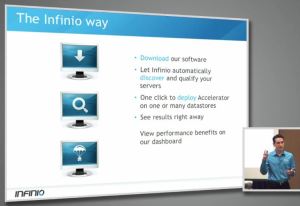
201306 TFD9 Infinio 01 Peter Smith Model

Peter Smith, Director of Product for Infinio, introducing the “Infinio Way” of deploying the Accelerator

Infinio is a two year old, 30ish-person startup whose Accelerator product is designed to be an easy drop-in to your VMware environment. They’re focusing on making the product easy to try (including substantial engineering focus on the installation process), simple and affordable to buy, and visibly useful to your environment as soon as possible.

CEO Arun Agarwal talked up the focus on the installation process, but even more interesting was his focus on the trial and sales model. This seemed important at the time, but as time passed, I really appreciated the idea more.

Just this past week, I downloaded a “free” VM from a much larger company, only to be told in a pushy followup email that I need to provide a phone number and mailing address and get trial licenses and talk to a sales guy on the phone to do anything with the “free” VM. It was annoying enough to get to this point, and I’m disinclined to actually buy and use that product.

I want a company to provide (1) enough information on their website for me to understand the product, (2) a hands-off model for acquiring and trying out the product (even if it’s at 2am on a Saturday because I can’t sleep and I’ve got a hundred servers sitting idle in a datacenter to play with), (3) smart and non-pushy people to help me with understanding, evaluating, and maybe buying the product if I do decide to move forward–when and if I need them, and not the other way around, and (4) a product that really solves the problem.

Infinio plans to provide all these things. You can download the trial without giving a lot of information (or any, as I recall), and you can buy your licenses with a credit card on the site. This would be a refreshing model, and I’m optimistic about their being able to do it.

So what are they doing?

I was wondering that too… and seeing the phrase “downloadable storage performance” a week or so before the visit, I was dubious.
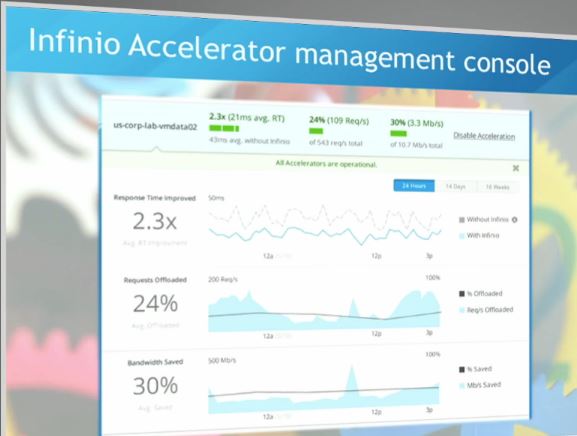
201306 TFD9 Infinio 02 Peter Smith DashboardThe Infinio Accelerator is a virtual NAS (NFS v3) accelerator for VMware. It sits between the vmkernel interface and the storage server on each host, providing a shared, deduplicated caching layer to improve performance across your systems. It also works transparently to both storage and server, so you don’t change your storage settings or ACLs (great for those of us who have siloed storage, networking, and virtualization management teams, and all the efficiencies they provide).

And possibly most impressive of all, you don’t have to reboot anything to install or remove the product.

The management console allows you to toggle acceleration on each datastore, and more importantly, monitor the performance and benefit you’re getting from the accelerator. They call out improvements in response time, request offload, and saved bandwidth to storage.

Let’s make this happen

201306 TFD9 Infinio 03 Peter Smith Improvement

It does make a difference.

Peter Smith demonstrated the Infinio Accelerator for us live, from downloading the installer from the Infinio home page (coming soon) to seeing it make a difference. The process, with questions and distractions included, came in around half an hour.

You download a ~28MB installer, and the installer will pull down about a CD’s worth of VM templates (the Accelerator and the management VM) while you go through the configuration process. (You can apparently work around this download if you need to for network/security reasons–this would be a good opportunity to enlist those smart and non-pushy people mentioned above.)

After the relatively brief installation (faster than checking for updates on a fresh Windows 7 installation, not including downloading and installing all 150 of them, mind you), Peter brought up a workload test with several parallel Linux kernel builds in 8 VMs, demonstrating a 4x speedup with the Accelerator in place even with the memory per VM halved to make room for the Accelerator.
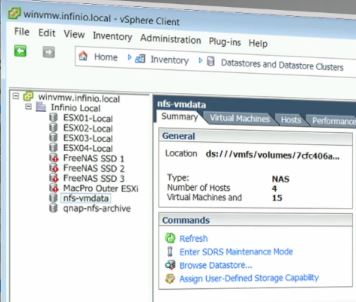
201306 TFD9 Infinio 04 Peter Smith vTARDIS

vTARDIS, MacPro flavor

An aside about making room for Infinio: The accelerator will eat 8GB of RAM, 2 vCPUs, and 15GB of local disk space on each hypervisor host you’re accelerating. It will also use 4GB RAM, 2 vCPUs, and 20GB of storage for the management VM, on one of your hosts. So if your virtualization lab is running on your 8GB laptop, you’re gonna have a bad time, but a quad-core lab system with 32GB of RAM should be practical for testing. A typical production hypervisor host (128GB or more) will probably not notice the loss.

And a further aside about the demo system. As a big fan of Simon Gallagher’s vTARDIS concept of nesting hypervisors, I was pleased to see that the Mac Pro the Infinio folks rolled in for the demo was effectively a vTARDIS in itself. This is a pretty cool way to protect your live demo from the randomness of Internet and VPN connectivities and the very real risk that someone will turn your lab back at the home office into a demo for someone else, if your product lends itself to being demonstrated this way.

Some future-proofing considerations

The team at Infinio were very open to the suggestions that came up during the talk.

They have a “brag bar” that offers the chance to tweet your resource savings, but they understood why some companies might not want that option to be there. Some of us work (or have worked) in environments where releasing infrastructure and performance info without running the gauntlet of PR and legal teams could get us punished and/or fired.

They took suggestions of external integration and external access to the product’s information too, from being able to monitor and report on the Accelerator’s performance in another dashboard, to being able to work with the Accelerator from vCops. And they’re working on multi-hypervisor (read: Hyper-V) support and acceleration of block storage. Just takes enough beer and prioritization, we were told. 

So where do we go from here?

Infinio is releasing a more public beta of the Accelerator at VMworld in San Francisco in just a couple of weeks. Stop by and see them if you’re at VMworld, or watch their website for more details about the easy-to-use trial. You can sign up to be notified about the beta release, or just watch for more details near the end of August.

The pricing will be per-socket, with 1 year of support included[1], and hopefully it will be practical for smaller environments as well as large ones. We will see pricing when the product goes to GA later this year.

I’m planning to get the beta to try out in my new lab environment, so stay tuned for news on that when it happens.

And if you’re one of the lucky ones to get a ticket for #CXIParty, you can thank the folks from Infinio there for sponsoring this event as well. And I may see you there.

Disclosure: Infinio were among the presenters/sponsors of Tech Field Day 9, to which I was a delegate in June 2013. While they and other sponsors provided for my travel and other expenses to attend TFD9, there was no assumption or requirement that I write about them, nor was any compensation offered or received in return for this or any other coverage of TFD9 sponsors/presenters.

Some other write-ups from TFD9 Delegates (if I missed yours, let me know and I’ll be happy to add it):

[1] Update: When we talked with Infinio in June, they planned to include 3 years of support with the initial purchase. They are now planning to include 1 year with renewals beyond that being a separate item. This should make the initial purchase more economical, and make budgeting easier as well.

Rough cut: HP Moonshot and CEO Meg Whitman at Nth Symposium 2013

I gotta say the withdrawal symptoms from daily Disneyland visits are getting milder, but I’m home from a week in Anaheim for HP Storage Tech Day  and Nth Generation’s 13th Symposium. If you didn’t see it, my preview was posted last month here on rsts11.

I’ll have some more detailed thoughts, including at least one topic that I hadn’t really expected to provoke so much thought, in the next few days. But I wanted to touch on two of the highlights from the Symposium while they’re fresh in my mind.

Disclaimer: Travel to HP Storage Tech Day/Nth Generation Symposium was paid for by HP; however, no monetary compensation is expected nor received for the content that is written in this blog.

Quick Overview of Nth Symposium

Nth Symposium is an annual partner and customer summit held by Nth Generation, the leading HP channel partner in southern California. They’ve done this thirteen times now, bringing customer technologists and executives together with HP and partner representatives for a very productive event. It’s free to qualified IT professionals, so I’d suggest checking it out next year if you are in the area.

Two of the three Nth Symposium keynotes were by execs I’ve worked for before. I was farther down the org chart from (now HP CEO) Meg Whitman when I was at the shopping.com division of eBay in 2006, but she gave the executive welcome at my new hire orientation. I reported to a VP at 3PAR who reported directly to (now HP Storage VP/GM) David Scott back in 2001. I knew both would be very impressive speakers for a keynote.

HP CEO Meg Whitman

HP CEO Meg Whitman (not channeling Clint Eastwood, don't worry)

HP CEO Meg Whitman (not channeling Clint Eastwood, don’t worry)

In a definite score for Nth Generation, they convinced Meg Whitman, president and CEO of HP, to give the headline keynote at this year’s symposium.

Whitman’s ability to know on a detailed level, communicate, and see the path forward for a hugely disparate business that probably seems like it’s going that-a-way at full speed in every direction is impressive.

The high level overview of the company’s direction, and the “New Style of IT,”  was to be expected, but her willingness and ability to field unstaged questions from the audience and respond to them in an honest and aware way was what really impressed me.

“Don’t be shy, remember, I ran for public office.”
–Meg Whitman

The three questions I remember involved cross-border ordering and SKU simplification (so that you can easily order the same model for delivery to multiple countries), support cohesiveness and contactability (and responsibility), and the morass that is hp.com.

Fellow blogger John Obeto was set up for a question when Meg called out Nigeria as one of the countries that would not see SKU simplification this year. But she acknowledged that the complexity was counterproductive, and that the company is already working to solve the problems for multinational customers.

Another attendee mentioned the challenges of finding the right contact for support, especially (as I recall) when multiple product lines are involved, or when your contacts at HP leave the company. Having had my HP account manager leave after my first order a couple of jobs ago, and having had her replacements actively and effectively lose my followup business in the months that followed, I know what a pain this can be.

Meg acknowledged the problem as a significant one, suggested using a partner or VAR as an aggregator for contacts within HP (since VARs would have more access to experts and resources within the HP organization), and concluded by offering her personal email address and committing to help until other paths are finalized.

But back to John, who came up to the microphone to decry the exclusion of Nigeria for the 2013 SKU project, and to mention something that probably everyone who has tried to used the HP site for anything but B2C e-commerce already knows… that hp.com is pretty difficult to navigate. Meg once again acknowledged the problem–see a pattern here?–and said that they were working on the business-to-business (B2B) and business-to-consumer (B2C) sites separately. One is already under a substantial reorganization, and the other will follow as soon as practical.

In general, I got the sense of Meg Whitman as a CEO being not entirely unlike the (parody) President Jimmy Carter’s fireside chat from Saturday Night Live in the late 70s. I wouldn’t ask her about acid experiences, but it seemed if you asked her about something even several levels down in the chain that was affecting customers, she’d know what was going on and be able to respond to it (or be willing to take the question on and find an answer).

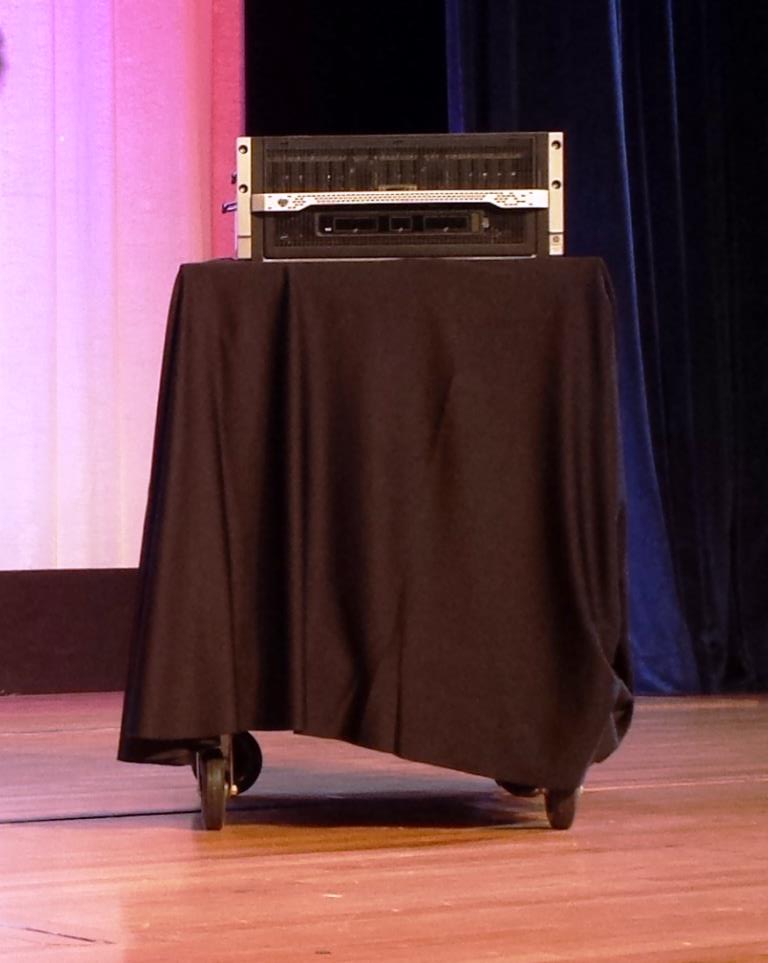
The Moonshot heard round the worldnth moonshot on stage

On the topic of hp.com, Paul Santeler put further time into the discussion of Moonshot in the talk that followed Meg’s keynote, but as I recall Meg also made the bullet point on Moonshot that hp.com now runs on Moonshot rather than a huge farm of servers.

To be specific, they’re using about 720 watts of power to run the whole site. Think about that… as she suggested, you probably use more power on lighting in your home than they do to run a large enterprise web site with support, e-commerce, marketing, and all sorts of other content. (Unless you’ve gone green–I think I’m at a bit under 700W between all the lighting in my home thanks to CFL bulbs, but steady-state power rating for these power supplies is 653W so they win.)

Moonshot is a sub-5U chassis that contains up to 45 server “cartridges” running the Intel Atom S1260 at 2GHz. The cartridge is a bit larger than a Kindle Fire and sports an 8GB ECC dimm, dual gigabit Ethernet (through a central switching module pair), and a single 2.5″ laptop-style hard drive that can be 500GB or 1TB of 7200rpm spinning disk a 200GB MLC SSD.

The 45G switching modules live in the center of the chassis, and the two 6SFP uplink modules give 6 1GBE/10GBE uplinks each via SFP+ connectors. Standard configuration gives you one switch module and one uplink module; the redundancy option is a custom configuration. A 40GBE module is coming soon. The systems are managed via iLO Chassis Management, and multiple systems can be daisy-chained.

If you’d seen the Seamicro systems circa 2009-2010, the Moonshot will seem like at least an evolutionary development from that concept. The first times I spoke with Seamicro about their 10U chassis, I asked about a smaller system, around 4U, with fewer than the stock 64 systems. Moonshot gives nearly the capacity of that 10U system, 40% more system RAM, dedicated per-system storage,  a third the footprint, and a lower power draw.

There are other cartridges coming, including an 8-core 32GB cassette (good for thin virtualization) and a DSP-targeted cassette (voice processing and so forth, running on ARM), so it shouldn’t be a one-trick pony platform. It won’t replace all rackmount and conventional blade servers, but hyperscale is likely to fill a few niches and simplify management and scalability.

So where do we go from here?

I’ve been a fan of 3PAR’s “Utility Storage” platform since I joined the company in 2001. (They’re now buzzwording around Polymorphic Storage which is also cool.)

One thing I asked about often during my time on Technology Drive in 2001-2002 was a smaller starting point for the InServ platform. With the E and F series, they made some steps in that direction, and I bought an E200 for high performance storage at Trulia a few years ago. But with their new 7200 model, they go even farther into the realm of possibility with a starting list price around $25k.

I’ll be bringing you some details on their platform and enhancements in the next week. I’ll also be looking at the comparison between utility computing platforms from HP and Cisco, a topic that was featured in one of the second tier keynotes.

Stay tuned, and wish me luck on the recovery from convention plague if you don’t mind.

Nth Generation and a different flavor of Field Day

tl;dr:

Check out HP Storage Tech Day 4 live streaming at  hpstorage.me/14RhvY0 starting Monday 7/29 at 8am Pacific/11am Eastern

Follow all of the attendees on twitter via this Twitter List (and follow @johnobeto and @geekazine as well–I couldn’t add them to the list)

Or follow the larger twitter conversations around these events at hashtags #HPTechDay and #NthSymp

Followup posts:

It’s going to be a busy summer

I just got back from a team-building event at Disneyland Park last week… and I’m headed back for Anaheim this weekend to join an auspicious group of technologists for the HP Storage Tech Day and then move on to the Nth Generation Symposium. Many thanks to HP for inviting me to the events.

Going back to 3PAR, to 3PAR, to 3PAR

628x471[1]It’s an odd reunion of sorts for me. As some of you know, I got my start in network administration supporting the Gigabit Ethernet group at a startup that became part of Nortel Networks.

A year after leaving Nortel, I got my start on non-local storage administration at a startup that became part of HP. I took over sysadmin duties at 3PAR in 2001, from a couple of developers who went back to doing the code (and yelling at me for not believing the All Functions In One Server gospel, but that’s another story), and went on to run the first InServ storage device in production outside the labs. 

So at the HP Tech Day, in addition to seeing some deep details on HP’s software defined storage and storage management platforms, we’ll be hearing from my former coworker, and now HP Fellow, Siamak Nazari on the StoreServ platform. There’s more coming after that, as @hpstorageguy Calvin Zito mentions on this “guest bloggers” post below the formidable list of Tech Day bloggers.

Then on to the Nth Symposium

NTH_Symposium_2013_Logo-transparent[1]Then we move on to three days at Nth Generation Symposium, a conference put on by HP’s channel partner in Southern California, Nth Generation. The keynote speaker will be HP CEO Meg Whitman, who I very indirectly worked for at eBay (she was the exec of the week at my eBay new hire orientation in 2006, which was pretty cool), but I’m also looking forward to seeing my boss’s  boss from 3PAR, HP Storage General Manager David Scott (pictured above during the HP/Dell bidding war).

You can join us, virtually…

There will be live streaming of the HP Tech Day, and some bits of Nth may see live coverage as well. Stay tuned here for further details on streaming and other resources, and check out some of the other Tech Day bloggers.

You can watch our tweets (and others) from now through the event at hashtags #HPTechDay and #NthSymp

I’ve created a Twitter list for these folks, in case you want to pull up a search window in your client. Feel free to use the HP Storage Tech Day 4 twitter list to watch what we’re seeing and doing during the event next Monday. (I couldn’t add John Obeto to the list for some reason, and I left Jeffrey Powers off because he was about 10x the tweet traffic of everyone else combined. Feel free to watch them separately if you like.

…or physically, for a modest sum…

If you’d like to attend the Nth Symposium, it’s apparently too late to get in free (that boat sailed July 19th, alas–hope my coworkers who kept saying they were going got registered and approved in time). However, for a modest fee you can still  join us at the Disneyland Hotel next week for an impressive agenda, featuring many HP execs as well as cool names from partner companies as well (Boyd Davis of Intel, Martin Casado of VMware, and quite a few others).

Rob’s highlights

For the HP Tech Day agenda, I’m especially looking forward to the StoreServ Deep Dive, and the storage management deep dive in the afternoon (with OpenStack). Obviously the 3PAR technology has come a long way since I rolled the gear across from 4245 to 4209 Technology Drive. They’ve made impressive moves since I bought my last system, an E-series at Trulia a few years ago. I tend to see more of the smaller scale/cutting edge storage tech at Tech Field Day events, so this should be a good balancing factor.

For the Nth Symposium, some of the key talks I’m looking forward to are:

Tuesday

  • Big Data Analytics (HP Autonomy)
  • New Style of IT (Meg Whitman)
  • HP and Cisco (Bill Swales, HP Industry Standard Servers)

Wednesday

  • Converged Storage (David Scott)
  • Hadoop, Vertica, and Applications (Girish Munada of HP HAVEn)

Thursday

  • Wicked Information (Noumenal)
  • Intelligent Hybrid Storage (X-IO Technologies)

ins_specialoffers_disneyland[1]And since it’s right there…

  • Depending on how worn out I am Tuesday night, I will probably be heading into the parks after the showcase closes. If I know you (it’s a small world…), touch base and maybe I’ll bring you along. 🙂

Disclaimer: Travel to HP Storage Tech Day/Nth Generation Symposium was paid for by HP; however, no monetary compensation is expected nor received for the content that is written in this blog.

A quick word on VAAI and FreeNAS/TrueNAS

[I have a lot of stuff in my head to tell you all about, but I also have a thousand square feet of inventory and storage to move an average of two miles this weekend… so keep an eye out for more lengthy posts coming later in the month. ]

I’m helping a friend’s startup get some infrastructure built, and one of the things I’m looking at is shoring up their VMware environment. They’re not ready for any of the common sub-six-letter names that usually come up for a vSphere storage platform yet… even a Celerra is overkill for five developers, I’d have to say.

So I was looking into VAAI support on the TrueNAS appliances from iXsystems (and of course FreeNAS itself). The first three search results I found were actually this blog, some cached twitter roll comments where I said I didn’t know if TrueNAS/FreeNAS supported VAAI.

truenas-search-rsts11

Well, I got it on good authority this afternoon that VAAI support is in the plans for FreeNAS over at iXsystems. There’s no current date for when it will be released, but they’ve jumped through a number of flaming hoops already to get ready, and will be keeping me (and you all by extension) up to date on progress.

For those of you using FreeNAS in your home lab, this probably won’t stop you from using it as shared storage for your VMware lab environment, or anything else for that matter. But if you’re considering TrueNAS for VMware storage, or need the full-on VAAI feature set, this will make things smoother in the foreseeable future.

And an unsolicited and uncompensated plug here (although if they want help testing a FreeNAS Mini Plus, they know where to find me)…

iXsystems are a hardware vendor who are a good friend to open source. They’re probably best known for their support of FreeBSD and FreeNAS (and Jordan Hubbard is joining them as new CTO this month), but they also sponsor Slackware, and make some cool storage appliances as well as a line of servers that come with open software history and support behind them. They’ve long been a friend of BayLISA, the Silicon Valley sysadmin group I’m involved with, as well as the Bay Area FreeBSD User Group and other organizations. Check them out if you’re looking for servers, workstations, or software.

Now back to moving… why did I need a Centillion 100 again? Anybody?

[PS: Welcome to all of you who followed iXsystems over here to my blog. For full disclosure, I am currently president of BayLISA, the Silicon Valley system administration user group, but this stuff is mostly written as Robert Novak, blogger, rather than Robert Novak, BayLISA cheerleader-in-chief.]

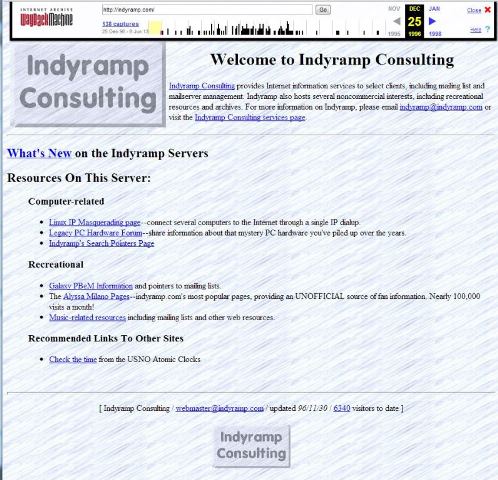
Indyramp is old enough to drink now!

www.indyramp.com as of December 1996 (earliest archive.org entry)

http://www.indyramp.com as of December 1996 (earliest archive.org entry)

Eighteen years ago today, my registration for indyramp.com went through.

Creation date: 03 Jul 1995 04:00:00

The next day, as I recall, the Network Solutions $100 registration charge for two years of service went into place. It later decreased, and my domains moved from Network Solutions to Joker.com (requiring a fax to Germany to confirm), to a friend’s OpenSRS/Tucows RSP, to GoDaddy, and finally to its current resting place at Namecheap.

Indyramp Consulting had been around a bit before that, originally designed to be a third Internet Service Provider in Indianapolis, Indiana. In those days, it still wasn’t completely insane to seriously consider introducing an ISP that didn’t offer SLIP or PPP connections. Anyway, that plan didn’t quite work out, and I took a job at one of the other two ISPs, IQuest, which is now called LightBound.

But I kept the Indyramp name around, registered the domain, and set up a couple of web sites on it–including my earliest claim to fame, the pop music page (and first Internet fan page of any sort) for Alyssa Milano.

In 1995, I had a dedicated dialup connection from IQuest (an employee perk), and hosted much of my site on a recased Gateway 2000 i386 PC with 16MB of DIP RAM on a riser board and a 540MB hard drive that dual-booted the October beta of Windows 95.

From 1996 to 2003 the site was hosted in my apartments in Hayward and then Milpitas, California, on various levels of dedicated hardware (from a SPARCstation IPC and SPARCstation 2 to various Pentium Pro workstations to a 19-server multivendor multi-OS “colo” in my spare bedroom in Milpitas).

In 2003, I had been laid off and the job market was challenging, and I moved from home-hosting to a virtual machine at Johncompanies.com (technically a FreeBSD jail, but virtually the same thing). The site is still hosted there just over 10 years later.

Between 1995 and the mid-2000s I hosted/ran many mailing lists, play-by-email games, the original website/mailing list for Linux IP Masquerading, and a few other random things that came up.

Nowadays it’s mostly email filtering and a screen session for irc, but the name is still there and I have a lot of history out there on the interwebs with Indyramp.

So happy 18th birthday to Indyramp. I’m pretty sure the Fitbit on my arm has more memory than the first server that hosted you, but ultimately the Fitbit didn’t get me into hosting and networking, out to California, and to where I am today.