It’s pilgrim time, people… #vExpert #CLUS #TFD9 #rsts11

Got your best John Wayne voice in mind?

April showers bring May flowers, and what do Mayflowers bring?

Pilgrims.

vexpert-tint

First, I’m honored and (at least) a little bit surprised to have been chosen as a VMware vExpert this year. To be in the company of both Scott Lowes, and several hundred other people who contribute to the VMware community, well, it’s an amazing category to be in.

I applied under the Evangelist Path because, while I work for a company that has more than a few VMware licenses, this is a category I qualify for under my own auspices. And the blog entries you’ve read, linked to, and followed in your own labs have been out of my own pocket and without benefit of a Fortune 100 company’s sway or budget.

Thanks to some of the benefits of the vExpert program, I expect to be able to expand my home lab and work on some new projects in the coming year, meet lots of new friends and cohorts, and contribute more of another voice to the VMware community. Although I suppose this means I should follow the recommended capitalization of VMware more consistently.

TFD-Logo-300

Speaking of pilgrims, I’ll be making a pilgrimage to Austin, Texas in just over three weeks to be a part of the All-Star All-Datacenter Tech Field Day 9. I know over half of the other delegates, having participated with them on previous field day events, and am looking forward to maybe remembering all of their names by the end of the week.

This is my first field day outside of Silicon Valley (unless you count the roundtables at Interop last month), so it should be interesting to actually have to go more than a 15 minute drive to join the rest of the delegates.

Tune in June 19-21 for live coverage of our conversations with Dell, Nutanix, Solarwinds, Veeam, Neverfail, Commvault, and a top secret stealth company I’m not allowed to name yet.

Update! As of June 4th, Infinio has outed themselves as the “top secret stealth company.” They describe themselves as “inventor of downloadable storage performance” (and I assume that’s storage performance enhancement that’s downloadable rather than being hardware). Looking forward to seeing what their Infinio Accelerator is and how it compares to other things on the market that sound like software-layer virtualization storage enhancement.

 

cisco-live-250

And speaking of pilgrims even more, well, I’ll at least be in the neighborhood of my employer’s largest campus when I head down to Orlando after TFD9 for the Cisco Live event.

I’ve been heavily involved in Cisco UCS for the past year and change, and am looking forward to exposure to more about Cisco’s datacenter platforms as well as maybe touching on other areas of their business. I probably won’t be able to turn my Cisco 1605R routers into SDN gear anytime soon, but I’ll survive.

Balancing-Act-001

And finally, as time permits I’m going to be evaluating and writing up a couple of SMB WAN load balancing solutions that have been introduced/enhanced recently. I had good conversations with two of the bigger names in SMB WAN aggregation and failover while at Interop earlier this month, and I’m looking forward to experimenting with some of their gear in the foreseeable future. You’ll probably see some of the names in my “How many Internets do you need?” post from March, and maybe a surprise or two if I’m lucky.

So stay tuned. And if there’s anything in the SMB (small/medium business) and/or POHU (psycho-overkill-home-user) market space you’re curious about, let me know and I’ll see if I can dig into it. Chime in on the comments below!


Mohs’ law and big data (Hadoop is hard)

I’ve spent more time than usual the past two weeks talking with people, and listening to people, about Hadoop. I’ve been administering Hadoop clusters for (part of) a living for about 4-5 years now, and I’ve gotten pretty good at answering questions people don’t have, or want, answers for.

In the past week or so I’ve heard one vendor advocate that Hadoop gives you a free analytics environment with no need for expensive developers since it’s free software, and another vendor advocated that you can just virtualize Hadoop by putting lots of  datanodes on a single host and save lots of money. Easy peasy, right?

no-just-no

 I’m proposing we consider Mohs’ Law in this situation.

No, I’m not misspelling Moore’s Law, which tells us that compute power/efficiency will double every 24 months. I’m suggesting a law that’s more of a diamond in the rough, if you don’t mind.

Hadoop is hard. 

 It’s based on Friedrich Mohs developing a method of describing hardness of materials about 200 years ago. And it’s a great pun. But it’s also a reminder that “yum install” does not a production application make.

But Rob, I can get Hadoop in 15 minutes!

yellow-hadoop

It is pretty easy to get started with Hadoop. It’s even free of charge to get started (or even to go into production) with the platform itself. I recommend it. Go do it now. I’ll wait.

For starters, go grab the Cloudera QuickStart VM or the Hortonworks Sandbox VM from their respective websites. Pull it into your desktop virtualization platform of choice. Look at the docs. Run some of the tests. At that point you’re farther along than most people who promote Hadoop.

But at that point you don’t have a functioning business intelligence/data warehouse/analytics application environment, any more than installing Ubuntu 13.04 into VirtualBox gives you a production e-commerce site.

There’s still a lot of work to be done. Some of it is difficult, but a fair bit of it is just downright hard. Understand what you want to do, what data you can pull into your environment. Figure out what your customers/users/analysts need out of the data. Make sure you can validate the output. Automate all your tests. Go back to your data sources and make sure you’re getting all the data. Go back to your end users and make sure you’re giving them what they want. Lather, rinse, repeat.

Rob’s Corollaries to Mohs’ Law

If you remember nothing else, think about an analytics environment the way you would a monitoring environment. I’ve supported both for almost a decade, and the take-home I’ll save you ten years on is this:

Make sure you’re measuring what you think you’re measuring.

Make sure you’re measuring what you need to be measuring.

This rule also applies to a lot of other technology… customer surveys, dating sites, and so forth. But it takes formidable effort to get these two corollaries right (without coronaries), and even if you do throw together something with Insta-analytics.com (probably not a real site, not meant as an endorsement), they won’t be able to tell you what you need or whether you’re getting it.

So where do we go from here?

First of all, if you’re interested in getting familiar with Hadoop, go grab a VM above and give it a try. Simulate Pi Indiana-style. Grab a book and try some of the stuff it suggests.

Then, go talk to the BI team in your company, or the analyst who does performance dashboards when she’s not writing code and designing employee event signage and chasing your kids out of the server closet, or whoever. Find out what they’re doing.

And finally, unless your vendor makes its livelihood supporting Hadoop, don’t take their take on Hadoop as gospel. Apocrypha maybe, mistranslation at worst, and probably not enough to go on.

Hey, I’m in Silicon Valley and want to learn more, what can I do?

Funny you should ask.

BayLISA is hosting a Hadoop meeting on Thursday, May 16, at Yahoo! in Sunnyvale. There’s a waiting list but it usually fades closer to the event. Come see Alan Gates of Hortonworks, Eric Sammer of Cloudera, and Ryan Orban of Nutanix talking about Hadoop innovations and how to get involved.  (Disclaimer: I am president of BayLISA, but I don’t get any profit or direct benefit if people come to the meetups.)

There’s also a Hadoop User Group meetup on Wednesday, May 15, although it’s a bit more suited to advanced users who are already familiar with the technology. Their waitlist is also a fair bit longer. But check it out and see if it fits your needs.

If you’re not in Silicon Valley, check Meetup for local groups, or see if one of the Hadoop vendors has local meetings or events you can attend. If you find one, feel free to add it in the comments here so other people will know where to look.

I survived Interop

I made it back from my first Interop expedition. I’m sure a lot of you are finding my blog as a result of meeting me at Interop — I owe a few of you an email to follow up on our conversations, and those will be going out next week. Feel free to initiate contact if you like, leave a comment, drop me an email, or catch me on Twitter.

I’d like to take a moment to thank Stephen Foskett and the Tech Field Day organization for faciliatating my Interop visit, as well as Spirent, NEC Networking, and Juniper Networks for sponsoring our activities and presence this week.  I’d also like to thank Jennifer “JJ” Jessup, General Manager of Interop, for her help dealing with an interesting PR contact before the event, and Jamie Porter from the UBM/Interop PR team for helping to set up a couple of meetings with exhibitors while I was there.

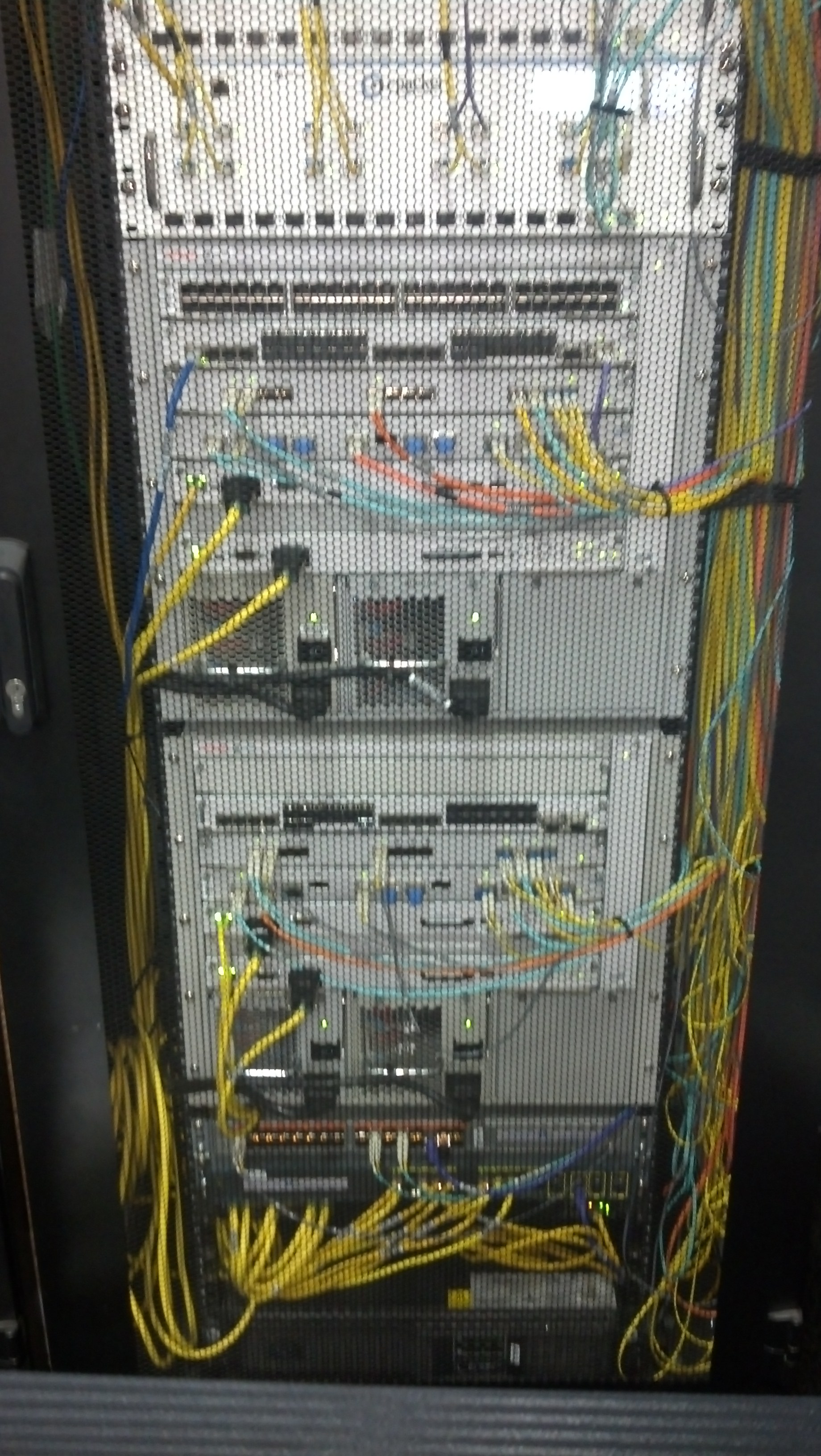
2013-05-09 12.05.40I met a  lot of interesting vendors, found some products and technologies to dig into more over the next couple of months, and managed to catch up on my email. There will be a couple more blog entries coming this month, but oddly one of the most impressive things I saw at Interop was that a couple of my babies were running in the core of the network.

From 1997 to 2000, I worked as the sysadmin for what used to be called Rapid City Communications. They brought out an Accelar line of routing switches with Gigabit Ethernet, got acquired by Bay networks, got acquired by Nortel Networks, and somewhere along the line converted to the Passport naming structure with the 8000 line of chassis switches. The picture to the right is the descendant of the 8606, which I probably built code for tens of thousands of times.

The Avaya fellow I spoke with came from Bay Networks… Avaya acquired Bay/Nortel’s Ethernet Routing Switch product line in 2009. Even if 10/100 with two 1GBE ports doesn’t seem that powerful anymore, and even if Nortel (and now Avaya) have had 10GBE for 12 years on the ERS8600 line, I still have a soft spot for the whole Accelar line, and always love seeing them turn up in places like the Tech Museum in San Jose and now Interop in Las Vegas.

Stay tuned for some further thoughts and experiments with WAN load balancing, Hadoop grumblings, and some interesting consumer tech that I’m expecting to try out in the foreseeable future. Thanks for dropping by.